| Mapping the Presidential Vote |
|
For a fantastic site about Presidential election maps, see http://www.270towin.com
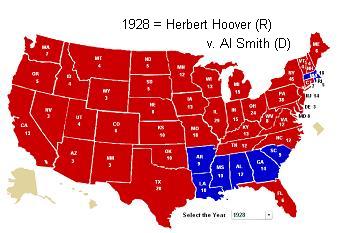
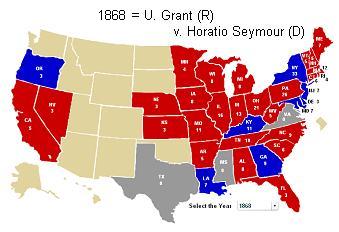
I've selected thumbnails from that site to illustrate the tremendous swings that have taken place in just a few years in presidential elections in U.S. history and to counter the impression many have that "you can't fight city hall", or that struggling to make major changes in our country is hopeless. 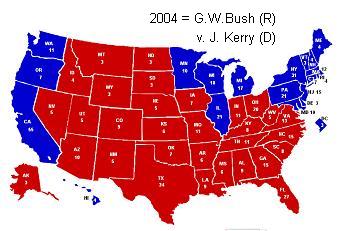
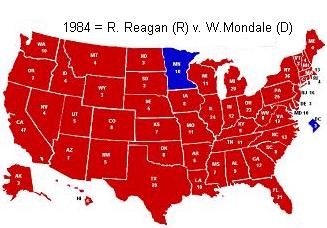
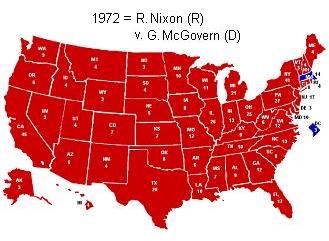
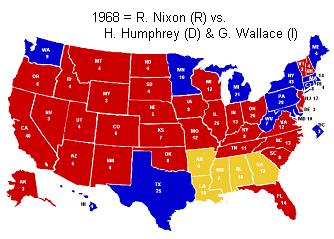
David Halberstam, in his book on the Civil Rights movement entitled "The Children", quotes Lyndon Johnson talking with Bill Moyers right after the Voting Rights Act of 1965 had passed by large margins in the Congress of the United States. This positive vote followed the arousing of the public's consciousness by the Abu Ghraib-like use of dogs and fire hoses on black citizens in Alabama. Klan groups, under the direct protection of Southern State Troopers and local police, had also attacked blacks with baseball bats and lead pipes in public places, which had been seen on national television. Moyers expected to find President Johnson jubilant over this legislative victory. Instead he found the President strangely silent. When Moyers enquired as to the reason, Johnson said rather prophetically, "Bill, I've just handed the South to the Republicans for fifty years, (until 2015) certainly for the rest of our life times." 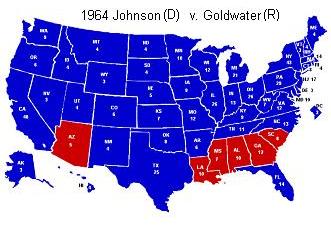
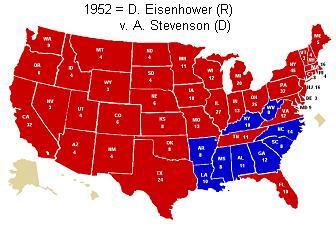
Who could have predicted that after overwhelmingly defeating the liberal Democratic candidate in 1928, the Republicans would be replaced in just 8 short years by Al Smith's successor as governor of New York, the equally Liberal Democrat Franklin D. Roosevelt, who would carry every state but Maine and Vermont, in 1936? 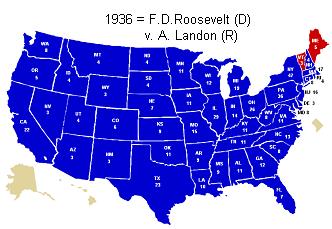
By the turn of the twentieth century the only Democratic states in the country were in the deep south. Who could have predicted that just 8 years later, the whole country would have turned Democratic? Although Woodrow WIlson was a Southern Democrat by upbringing and sadly never outgrew his racism, he was one of the first new breed Liberal Democrats in many respects. and one of the reasons that he won so many states in 1912 is that the Republican leaders had rejected their own liberal and very popular former president Teddy Roosevelt, and chosen instead to try to keep the much more conservative Howard Taft in office. 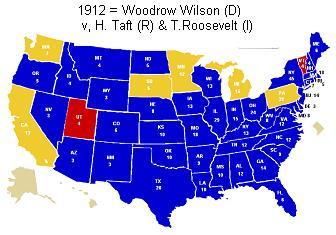
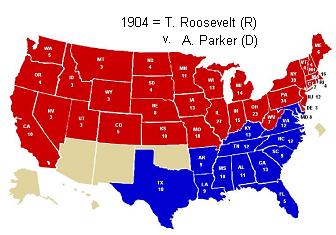
Immediately after the Civil War, in 1868, the Republican victors controlled most of the country. But by 1880, the white Conservative Democrats were back in control of the former Confederate states, while the rest of "the union" remained Republican. 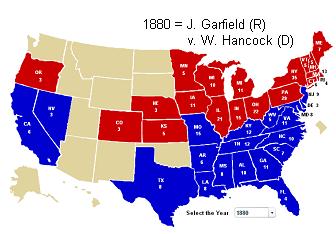
|
After reading a great article by Paul Rosenberg, published on Dec 22, 2007 at http://www.openleft.com/showDiary.do;jsessionid=16CAF334C0764FB3489EF179B54CB586?diaryId=2899 , I decided to try to enhance the point he made there with the tables below. Rosenberg's excellent point was that there is no basis in American history for the currently popular idea that the ideal in politics is to find a happy consensus "in the middle". On the contrary, politics is essentially a contest between parties representing rival points of view and that most of the time Americans have chosen between those rivals and given both houses of Congress and the presidency to one side or the other. If Americans want a government that gets things done, they need to do what their predecessors did and put the party that best represents their wishes in charge of the House, the Senate and the presidency simultaneously.
|
|
Liberal vs. Conservative Administrations: To see how much better the country has done under Democratic rather than G.O.P. administrations since that party became the nation's liberal party, in the 1930's, see Liberal-Insights.Org/Democrats/. |
||
| 1853 - 1856 | Democrat | Franklin Pierce |
| 1857 - 1860 | Democrat | James Buchanan |
| 1861 - 1865 | Republican | Abraham Lincoln |
| 1865 - 1868 | Democrat | Andrew Johnson |
| 1869 - 1872 | Republican | Ulysses S. Grant |
| 1873 - 1876 | Republican | Ulysses S. Grant |
| 1877 - 1880 | Republican | Rutherford Hayes |
| 1885 - 1888 | Democrat | Grover Cleveland |
| 1889 - 1892 | Republican | Benjamin Harrison |
| 1893 - 1896 | Democrat | Grover Cleveland |
| 1897 - 1901 | Republican | William McKinley, Jr. |
| 1901 - 1904 | Republican | Theodore Roosevelt, Jr. |
| 1905 - 1908 | Republican | Theodore Roosevelt, Jr. |
| 1909 - 1912 | Republican | Howard Taft, |
| 1913 - 1916 | Democrat | Woodrow Wilson |
| 1917 - 1920 | Democrat | Woodrow Wilson |
| 1921 - 1924 | Republican | Warren Harding |
| 1925 - 1928 | Republican | Calvin Coolidge, Jr. |
| 1929 - 1932 | Republican | Herbert Hoover. |
| 1933 - 1936 | Democrat | Franklin D Roosevelt |
| 1937 - 1940 | Democrat | Franklin D Roosevelt |
| 1941 - 1944 | Democrat | Franklin D Roosevelt |
| 1945 - 1945 | Democrat | Franklin D Roosevelt |
| 1945 - 1948 | Democrat | Harry S. Truman |
| 1949 - 1952 | Democrat | Harry S. Truman |
| 1953 - 1956 | Republican | Dwight D. Eisenhower |
| 1958 - 1960 | Republican | Dwight D. Eisenhower |
| 1961 - 1964 | Democrat | J.F. Kennedy - Johnson |
| 1965 - 1968 | Democrat | Lyndon Johnson |
| 1969 - 1973 | Republican | Richard M. Nixon |
| 1973 - 1976 | Republican | Nixon & Gerald Ford |
| 1977 - 1980 | Democrat | Jimmy Carter |
| 1981 - 1984 | Republican | Ronald Reagan |
| 1985 - 1988 | Republican | Ronald Reagan |
| 1989 - 1992 | Republican | George W. H. Bush |
| 1993 - 1996 | Democrat | Bill Clinton |
| 1997 - 2000 | Democrat | Bill Clinton |
| 2001 - 2004 | Republican | George W. Bush |
| 2005 - 2008 | Republican | George W. Bush |
Contact  [email protected] There is much more where this came from, at  and/or 
|