+ - + - + - + - + - +
Mutually Exclusive ?

| |
Are Politics and Religion + - + - + - + - + - + Mutually Exclusive ? |
|
|
When faith and reason collide, Has anyone else noticed how both Liberals and Conservatives complain loudly about "mixing of politics and religion", but only when that mixing benefits the other side? Attribute this behavior to dishonesty if you will, but as often as not, it may simply be a result of honest confusion over issues that are - by their nature after all - extremely confusing? Is there anyone who can deny that "religion", on the one hand, is a very complicated matter; and that, on the other hand, "politics" is no less complicated? Just imagine not only trying to hold onto these two complexities in each of your hands, but then trying to juggle them, along with all the other concerns of life! Tough, isn't it? Now add to the situation that you are doing all of this in competition with opponents who are trying to make you fail at the endeavor!
|
|
|
Click HERE for the CIVIC reasons why - despite "the wall of Separation between Church and State," religion cannot and should not be separated from politics. |
Click HERE, for the RELIGIOUS reasons why the claim made by many pious Christians that "religion has no business getting mixed up with politics" is contrary to what both the bible and US history teach us. |
|
The CIVIC Perspective Most well-informed Americans agree that our two century experiment with the "separation of Church and State has proven rather conclusively that it is best for both when our civil governments and our churches have virtually no control over each other.
|
||
 |
The realm of |
The realm of |
At the Personal level |
while Values cannot be separated |
|
One's |
||
|
One's |
||
|
At the public level, |
Institutions must be kept separate. |
|
States |
||
|
Churches |
||
|
Is not "politics," in its original meaning, simply the way in which the public life of the people ("polis" in Greek) is organized? A community's "politics" may be determined by the people themselves ( in the various types of democracies ), or imposed on it by other persons or groups ( in the various types of "dictatorships" - benevolent or otherwise ). While private morality is none of the government's business, because it has to do only with the individuals in question, public morality is pretty much what government is all about. Think about it, isn't the justification for government getting involved with any activity the fact that the activity in question impacts the public? Abraham Lincoln said that the government is the organization of people to do for one another collectively what they could not do as well or at all individually and privately. The Judicial branch of government deals with public immorality after the fact, investigating public wrong-doing, arresting the "perps", passing judgement, and punishing appropriately. The Legislative branch of government, on the other hand, deals with public immorality before the fact, trying to prevent public wrong-doing, by defining it and establishing penalties to either deter wrong-doing or punish it. shows why Liberal Democrats have the most to gain from the participation of true Christians in America's politics. See the fantastic "Bushflash video" on the Republican Party's disdain for the Separation of Church and State And here's a great article about the religious views of our first seven presidents, The Founding Fathers were not Bible-thumpers. | ||
"Those who say religion has nothing to do with politics
The Religious Perspective : Politics and the BibleMany people who have the view that "religion has no business getting mixed up in politics" mistakenly believe that just because the word "politics" isn't used in the Bible, there is no place for politics in their religion and vice versa. The word "politics" is often used these days to refer to the competition for votes, and in that sense, politics is fairly new. In the "good old days", of course, politicians didn't need to compete for votes because it was either inheritance that determined who "lorded it over" others, or brute force. Inheritance may have avoided the messy "politics" that we are used to in countries like America today, but history is replete with examples of plots and wars being fought either to prevent people from inheriting high office or to remove them after they were crowned. Some Christians think that Jesus was too lofty a person to be associated with something as earthy as "politics". They says things like, "Christ is apolitical. He would be neither Republican or Democrat." or "He wouldn't be a politician." Why not. Was he not a man? If he chose to be a Jew, and a Galilean 2000 years ago, why couldn't he have been a Republican or a Democrat, if he chose to return as an American in our day? If he could get dirty hands and feet and have to relieve his bowels every day or so, why is it inconceivable that he could view one political party as much more deserving of support than others? Most of the Gospels are devoted entirely to the three years of Jesus' "public" and political life. (Even the infancy narrative involves political intrigue by the local King to have Jesus killed before he could threaten Herod's throne.) When the Gospels had nothing to say about the private life of Jesus, they filled the void by concentrating instead on his cousin, John the Baptist, who went public before Jesus and suffered death at the hands of the politicians before Jesus did. Many Christians don't recognize how much of the public life and preaching of Jesus had to do with "politics" because they fail to realize that the "scribes", the "lawyers" and the "priests" with whom Jesus did battle constantly were not just the religious rulers of his day. They were the "political" rulers as well, at the local level. Apart from requiring the collection taxes (by Jewish locals) and building roads and forts to use in preserving and/or extending the Roman empire, the Romans had little interest in the day-to-day management of local affairs. All of that the Romans left to the local clergy, something not unheard of even today in less developed areas of our world. Another famous Gandhi quote on this subject is "My politics is my religion, my religion is my politics". |
" Render unto Caesar . . ." IMHO many who quote Jesus on this score miss the point entirely. Many use this passage, for example, in support of the separation of Church and State. Here is the passage and its important context, from Matthew 22: 15-22 : Then the Pharisees went and plotted to entrap him in what he said.
So they sent their disciples to him, along with the Herodians, saying, "Teacher, we know that you are sincere, and teach the way of God in accordance with truth, and show deference to no one; for you do not regard people with partiality. Tell us, then, what you think. Is it lawful to pay taxes to the emperor, or not?" First of all, readers of this passage need to underestand what this "testing" was all about. The context is that the Jews were under the domination of the Romans. Nobody likes paying taxes, but having to pay taxes to support a government that worships Caesar instead of Yahweh, Oiveh! These politicians expected to use Jesus' answer to either arouse the pious Jews against Jesus or the Roman authorities against him. Jesus came up with a clever answer, one which got him out of the hot water his opponents had put him in, but what are the ramifications of these words over time? Did Jesus believe and teach his followers to believe that they should always cooperate with whoever is in charge? That may be what Paul of Tarsus taught very explicitly and unequivocally in Romans 13, but I don't think that was Jesus' intention here. My own guess is that Jesus recommended "rendering to Caesar that which is Caesar's", because he anticipated the alternative, i.e. the destruction of the whole Jewish nation by Caesar, which is in fact exactly what took place just a few years later. |
|
Why America shouldn't be a "Theocracy" Literally, the word "theocracy" means "government by God". But in reality, theocracies always end up being government by God's surrogates, i. e. the clergy, because God hasn't been known to "micromanage" the world much since creating it. From the beginning of time, all kinds of clergy have claimed God (or gods) as the author of policies which they the clergy administer. In a modern country like America, there are two reasons why the clergy should not be involved in the management of "secular" affairs :
Hitler was a modern version of that senator. As John Cornwell pointed out in his sensational book, "Hitler's Pope, The Secret History of Pius XII", and which inspired a good deal of our LiberalsLikeChrist.Org/RCscandal.html page : "Hitler had two views on the churches - public and private. In February of 1933 he was to declare (his public relations position) in the Reichstag that the churches were to be an integral part of German national life. Privately, the following month, he vowed to completely 'erardicate' Christianity from Germany. 'You are either a Christian or a German,' he said. ' You cannot be both." (pp. 105-06) Before Pacelli's Reich Concordat of 1933 with Hitler, Germany's Catholic "Center Party" was one of the only serious obstacles left for the National Socialist Party to overcome in its quest for complete control of Germany. Thanks, however, to that " pact with the devil", the Papal Nuncio Pacelli (the future Pius XII) acceded to Hitler's demands that the Church keep its clergy and membership "out of politics", in exchange for the State staying out of "purely religious" or "celestial" matters. ( Both "Church" and "State" ended up being defined by the NAZI rulers, as earthly and celestial. ) Soon thereafter, the Center Party, along with every other Catholic organization that might be considered "political" was persuaded to close shop and / or "stay out of politics". "Secular schools can never be tolerated because such a school has no
religious instruction and a general moral instruction without a religious foundation is built on air; consequently, all character training and religion must be derived from faith . . . We need believing people." ( Adolf Hitler, April 26, 1933, from a speech made during negotiations leading to the NAZI-Vatican Concordat of 1933). Alexis de Tocqueville had this unique insight on the role of religion in America's public life : "Those who would renegotiate the boundaries between church and state must therefore answer a difficult question: Why would we trade a system that has served us so well for one that has served others so poorly"? ~~ Supreme Court Justice Sandra Day O'Connor |
|
|
Conservative Christian "scholarship" regarding Church and State in America : In order to make the case that Christianity is entitled to preferential treatment in the United States, some so-called Christian scholars publicize arguments about American history that demonstrate that they are either uninformed, dishonest or possibly both. The following material comes from the Snopes page Snopes.com/politics/religion/capital.asp, but is presented here in a format designed by Ray Dubuque to make the contrast between falsehood and truth more obvious. |
|
|
Regarding this section of artwork on the U.S. Supreme Court building 
|
|
| THIS column presents the phoney scholarship of Conservative Christians. |
THIS column shows what TRUE scholarship reveals: |
|
Totally uninformed Conservative writers tell their followers: |
"The United States Capitol does not house the Supreme Court of the United States. The Supreme Court has met in its own building since 1935. |
| THIS column presents the phoney scholarship of Conservative Christians. |
THIS column shows what TRUE scholarship reveals: |
|
"As you enter the Supreme Court courtroom, the two huge oak doors have the Ten Commandments engraved on each lower portion of each door. " |
The doors of the Supreme Court courtroom don't literally have the "Ten Commandments engraved on each lower portion" � the lower portions of the two doors are engraved with a symbolic depiction, two tablets bearing only the Roman numerals I through V and VI through X. As discussed in the next item, these symbols represent something other than the Ten Commandments." |
|
"As you sit inside the courtroom, you can see the wall right above where the Supreme Court judges sit a display of the Ten Commandments!" |
"The wall "right above where the Supreme Court judges sit" is the east wall, on which is displayed a frieze designed by sculptor Adolph A. Weinman. The frieze features two male figures who represent the Majesty of Law and the Power of Government, flanked on the left side by a group of figures representing Wisdom, and on the right side by a group of figures representing Justice:
|
Uninformed preachers only get away with the claim that the Ten Commandments ( Exodus 20: 1-17) are the inspiration underlying the U.S. Constitution when they are blessed with an audience of "believers" who have never read that Constitution, which has little to do with any of these Ten Commandments of the Bible:
In a debate with Marvin Olasky, the militant atheist Christopher Hitchens asked the significant question: "Prior to receiving these commandments on Mt. Sinai, did the Jews think that murder, lying, stealing and cheating were OK?" (or do people naturally know right from wrong, when and where it matters?) | ||
|
Quotes from the Founding Fathers While both sides argue as though their's was an open and shut case,
the truth is much more complicated than those at either extreme tell |
|
|
Quotes appearing to
Support CONNECTION of Church & State : |
Quotes appearing to
Support SEPARATION of Church & State : |
|
"The first President, George Washington, knew the decision to call for independence from England was momentous. Washington was known as a Christian man. On June 1, 1774, as the colonies were seeking God's will as to whether they should rebel against certain English laws, he wrote in his diary, '. . . went to church and fasted all day.' |
In a 1792 letter, George Washington wrote : "I was in hopes that the enlightened and liberal policy, which has marked the present age, would at least have reconciled Christians of every denomination so far that we should never again see the religious disputes carried to such a pitch as to endanger the peace of society."
|
|
"John Adams was the second President and one of the signers of the Declaration of Independence. On June 28, 1813, in a letter to Thomas Jefferson, he said, 'The general principles, on which the Fathers (the founders of America) achieved independence, were the only principles in which that beautiful assembly of young gentlemen could unite. . . And what were these general Principles? I answer, the general Principles of Christianity, in which all these Sects (denominations) were united. . .'
John Adams wrote: 'Our Constitution was made only for a moral and religious people. It is wholly inadequate to the government of any other.' Here's another quote erroneously attributed to John Quincy Adams: |
John Adams, the country's second president, was drawn to the study of law but faced pressure from his father to become a clergyman. He wrote that he found among the lawyers 'noble and gallant achievements' but among the clergy, the 'pretended sanctity of some absolute dunces'. Late in life he wrote: 'Twenty times in the course of my late reading, have I been upon the point of breaking out, This would be the best of all possible worlds, if there were no religion in it!' and |
|
Thomas Jefferson, the man "blamed" for the wall of separation between church and state said:
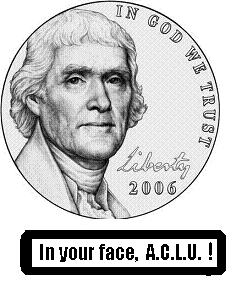 |
Thomas Jefferson, third president and author of the Declaration of Independence, said:'I trust that there is not a young man now living in the United States who will not die a Unitarian.'
He referred to the Revelation of St. John as 'the ravings of a maniac' and wrote: |
|
- James Madison, letter objecting to the use of government land for
churches, 1803
|
James Madison, fourth president and father of the Constitution, was not religious in any conventional sense. |
|
More Quotes appearing to
Support CONNECTION of Church & State : |
More Quotes appearing to
Support SEPARATION of Church & State : |
|
"Patrick Henry, that patriot and Founding Father of our country said, 'It cannot be emphasized too strongly or too often that this great nation was founded not by religionists but by Christians . . . not on religions but on the Gospel of Jesus Christ'. " |
"Another spurious quotation. These words appear nowhere in the writings or recorded utterances of Patrick Henry." |
|
"Every session of Congress begins with a prayer by a paid preacher . . . whose salary has been paid by the taxpayer since 1777." |
"Congress has indeed retained paid (Christian) chaplains since 1789 (not 1777) to open sessions with prayer and to provide spiritual guidance to members and their staffs upon request. (But) This practice was strongly opposed by James Madison at its inception." |
| The constitutional propriety of Congressional chaplains has been challenged in an August 2002 lawsuit filed in federal district court by Michael A. Newdow, (the California man who won a federal appellate court decision against the use of the phrase 'under God' in public school-led recitations of the Pledge of Allegiance). The case is still pending." |
|
|
First chief justice of the U.S. Supreme Court, John Jay, wrote: As recently as 1952 Justice William O. Douglas wrote: 'Is it not that the Declaration of Independence first organized the social compact on the Foundation of the Redeemer's mission upon earth? That it laid the cornerstone of human government upon the first precepts of Christianity?' |
Thomas Paine was a pamphleteer whose manifestos encouraged the faltering spirits of the country and aided materially in winning the war of Independence: Ethan Allen, whose capture of Fort Ticonderoga while commanding the Green Mountain Boys helped inspire Congress and the country to pursue the War of Independence, said, Benjamin Franklin, delegate to the Continental Congress and the Constitutional Convention, said: |
|
"Fifty-two of the 55 founders of the Constitution were members of the established orthodox churches in the colonies." |
"The diverse beliefs and religiosity of America's founding fathers is a complex subject, one which cannot be so neatly encapsulated by an (inadequately substantiated) statement such as the one quoted". . . |
|
Interesting sites and articles relating to Church and State : God on the ballot, by Alex Johnson, MSNBC Reporter, Sept. 15, 2004
|
| The great Conservative spokesman, Senator Barry Goldwater, viewed the "Religious Right" as a threat to the Conservatism that he represented and to the well-being of the Republican Party: When the first President Bush was running for the office, he declared "I don't know that atheists should be considered as citizens, nor should they be considered patriots. This is one nation under God." And follow-ups showed that he really meant it. See www.evilbible.com/Retard_May_2004.htm. A great column guardian.co.uk/comment/story/0,3604,1028758,00.html: "God help America. US law insists on the separation of church and state. So why does religion now govern there? "
 |
Frederick Douglass was an extraordinary man, who not only managed to throw off the shackles of slavery but went far beyond the conventional wisdom of his enslavers. In his autobiography, he contrasted the Christianity that prevailed in the southern part of America at least in his day, and the Christianity of Christ : 
" I find, since reading over the foregoing Narrative that I have, in several instances, spoken in such a tone and manner, respecting religion, as may possibly lead those unacquainted with my religious views to suppose me an opponent of all religion. To remove the liability of such misapprehension, I deem it proper to append the following brief explanation. Slavery has been banned in the South since that was written. But does that mean that the Christianity in the deep South isn't what it used to be? If so, why did David Duke, the handsome leader of the KKK who wears expensive business suits instead of bed sheets garner 60% of the white Christian vote when he ran for governor of the very Christian state of Louisiana? To see how the so-called "Christians" of the Old South use "God's Word" to justify their white supremacy racism, see http://JesusWouldBeFurious.Org /christianconservatism.html. Sadly the Conservative Christianity that many African Americans believe in today is a legacy left to them by ancestors who inherited it from their Christian white masters, as they demonstrate when they are as hard-hearted toward homosexuals as any Southern "red neck". They quote the bible to oppress gays, just as effectively as the masters of old used it to oppress their ancestors. Harris, church and state posted by Jim Stratton on Aug 24, 2006 http://blogs.orlandosentinel.com/news_politics/2006/08/harris_church_a.html "U.S. Representative Katherine Harris (who is campaigning for a seat in the U.S. Senate) said this week that the separation of church state is 'a lie,' that God did not intend for the United States to be a 'nation of secular laws' and that a failure to elect Christians to political office will allow lawmaking bodies to 'legislate sin.' |
The perfect compromise : Regarding the conflict over religious teaching in public schools, I have a challenge for Christian Conservatives:
Here's a good study of the religious beliefs of our founding fathers: http://earlyamericanhistory.net/founding_fathers.htm. |
Contact  [email protected] There is much more where this came from, at  and/or  See why you may already be one of us ! |