Best Non Gamstop CasinosUK Gambling Sites Not On GamstopUK Casinos Not On GamstopNon Gamstop CasinosCasinos Not On Gamstop
[  http://liberalslikechrist.org/Kingdream.html  ]

( The "vision" of the www.LiberalsLikeChrist.Org web site
is much like the "dream" that Rev. King described in
the brown text of this great sermon.
He would likely be the last to object to extending his vision to
other downtrodden people of other nations of the world. )

�We must learn to live together as brothers
or perish together as fools.�

Martin Luther King,Jr

  delivered on August 28, 1963
at the Lincoln Memorial, in Washington D.C.

        Five score years ago, a great American, in whose symbolic shadow we stand signed the Emancipation Proclamation.  This momentous decree came as a great beacon light of hope to millions of Negro slaves who had been seared in the flames of withering injustice.  It came as a joyous daybreak to end the long night of captivity.
       But one hundred years later, we must face the tragic fact that the Negro is still not free.  One hundred years later, the life of the Negro is still sadly crippled by the manacles of segregation and the chains of discrimination.  One hundred years later, the Negro lives on a lonely island of poverty in the midst of a vast ocean of material prosperity.  One hundred years later, the Negro is still languishing in the corners of American society and finds himself in exile in his own land.  So we have come here today to dramatize an appalling condition.
        In a sense we have come to our nation's capital to cash a check.  When the architects of our republic wrote the magnificent words of the Constitution and the Declaration of Independence, they were signing a promissory note to which every American was to fall heir.  This note was a promise that all men would be guaranteed the inalienable rights of life, liberty, and the pursuit of happiness.
        It is obvious today that America has defaulted on this promissory note insofar as her citizens of color are concerned.  Instead of honoring this sacred obligation, America has given the Negro people a bad check which has come back marked "insufficient funds."  But we refuse to believe that the bank of justice is bankrupt.  We refuse to believe that there are insufficient funds in the great vaults of opportunity of this nation.  So we have come to cash this check - a check that will give us upon demand the riches of freedom and the security of justice.  We have also come to this hallowed spot to remind America of the fierce urgency of now.  This is no time to engage in the luxury of cooling off or to take the tranquilizing drug of gradualism.  Now is the time to rise from the dark and desolate valley of segregation to the sunlit path of racial justice.  Now is the time to open the doors of opportunity to all of God's children.  Now is the time to lift our nation from the quicksands of racial injustice to the solid rock of brotherhood.
        It would be fatal for the nation to overlook the urgency of the moment and to underestimate the determination of the Negro.  This sweltering summer of the Negro's legitimate discontent will not pass until there is an invigorating autumn of freedom and equality.  Nineteen sixty-three is not an end, but a beginning.  Those who hope that the Negro needed to blow off steam and will now be content will have a rude awakening if the nation returns to business as usual.  There will be neither rest nor tranquility in America until the Negro is granted his citizenship rights.  The whirlwinds of revolt will continue to shake the foundations of our nation until the bright day of justice emerges.
        But there is something that I must say to my people who stand on the warm threshold which leads into the palace of justice.  In the process of gaining our rightful place we must not be guilty of wrongful deeds.  Let us not seek to satisfy our thirst for freedom by drinking from the cup of bitterness and hatred.
        We must forever conduct our struggle on the high plane of dignity and discipline.  We must not allow our creative protest to degenerate into physical violence.  Again and again we must rise to the majestic heights of meeting physical force with soul force.  The marvelous new militancy which has engulfed the Negro community must not lead us to distrust of all white people, for many of our white brothers, as evidenced by their presence here today, have come to realize that their destiny is tied up with our destiny and their freedom is inextricably bound to our freedom.  We cannot walk alone.
        And as we walk, we must make the pledge that we shall march ahead.  We cannot turn back. There are those who are asking the devotees of civil rights, "When will you be satisfied?" We can never be satisfied as long as our bodies, heavy with the fatigue of travel, cannot gain lodging in the motels of the highways and the hotels of the cities.  We cannot be satisfied as long as the Negro's basic mobility is from a smaller ghetto to a larger one.  We can never be satisfied as long as a Negro in Mississippi cannot vote and a Negro in New York believes he has nothing for which to vote.  No, no, we are not satisfied, and we will not be satisfied until justice rolls down like waters and righteousness like a mighty stream.
        I am not unmindful that some of you have come here out of great trials and tribulations.  Some of you have come fresh from narrow cells.  Some of you have come from areas where your quest for freedom left you battered by the storms of persecution and staggered by the winds of police brutality.  You have been the veterans of creative suffering.  Continue to work with the faith that unearned suffering is redemptive.
        Go back to Mississippi, go back to Alabama, go back to Georgia, go back to Louisiana, go back to the slums and ghettos of our northern cities, knowing that somehow this situation can and will be changed.  Let us not wallow in the valley of despair.

        I say to you today, my friends, that in spite of the difficulties and frustrations of the moment, I still have a dream.  It is a dream deeply rooted in the American dream.
        I have a dream that one day this nation will rise up and live out the true meaning of its creed: "We hold these truths to be self-evident: that all men are created equal."
        I have a dream that one day on the red hills of Georgia the sons of former slaves and the sons of former slaveowners will be able to sit down together at a table of brotherhood.
        I have a dream that one day even the state of Mississippi, a desert state, sweltering with the heat of injustice and oppression, will be transformed into an oasis of freedom and justice.
        I have a dream that my four children will one day live in a nation where they will not be judged by the color of their skin but by the content of their character.
        I have a dream today.
        I have a dream that one day the state of Alabama, whose governor's lips are presently dripping with the words of interposition and nullification, will be transformed into a situation where little black boys and black girls will be able to join hands with little white boys and white girls and walk together as sisters and brothers.
        I have a dream today.
        I have a dream that one day every valley shall be exalted, every hill and mountain shall be made low, the rough places will be made plain, and the crooked places will be made straight, and the glory of the Lord shall be revealed, and all flesh shall see it together.
        This is our hope.  This is the faith with which I return to the South.  With this faith we will be able to hew out of the mountain of despair a stone of hope.  With this faith we will be able to transform the jangling discords of our nation into a beautiful symphony of brotherhood.  With this faith we will be able to work together, to pray together, to struggle together, to go to jail together, to stand up for freedom together, knowing that we will be free one day.
        This will be the day when all of God's children will be able to sing with a new meaning, "My country, 'tis of thee, sweet land of liberty, of thee I sing.  Land where my fathers died, land of the pilgrim's pride, from every mountainside, let freedom ring."
        And if America is to be a great nation this must become true.  So let freedom ring from the prodigious hilltops of New Hampshire.  Let freedom ring from the mighty mountains of New York.  Let freedom ring from the heightening Alleghenies of Pennsylvania!
        Let freedom ring from the snowcapped Rockies of Colorado!
        Let freedom ring from the curvaceous peaks of California!
        But not only that; let freedom ring from Stone Mountain of Georgia!
        Let freedom ring from Lookout Mountain of Tennessee!
        Let freedom ring from every hill and every molehill of Mississippi.  From every mountainside, let freedom ring.

        When we let freedom ring, when we let it ring from every village and every hamlet, from every state and every city, we will be able to speed up that day when all of God's children, black men and white men, Jews and Gentiles, Protestants and Catholics, will be able to join hands and sing in the words of the old Negro spiritual, "Free at last! free at last! thank God Almighty, we are free at last!"

Martin Luther King, Jr.

"Jesus [is] the world's most famous liberal."

"Our lives begin to end the day we become silent
about things that matter"

"If physical death is the price I must pay
to free my white brothers and sisters
from the permanent death of the spirit,
then nothing could be more redemptive."

"St. Augustine, Florida "   June 5, 1964


Click here to hear MLK's own voice.

        See this excellent article by Earl Ofari Hutchinson on How Conservative was Dr. King
        Some Republicans peddlers of deceit, including the National Black Republican Association, have claimed that Dr. King was a Republican. A Martin Luther King Jr. biographer and a senior researcher with the Atlanta-based King Center told the Associated Press that the Reverend was non-partisan and that he never endorsed any politician from either of the parties. "I think it's highly inaccurate to say he was a Republican because there's really no evidence," King Center researcher Steve Klein told the Associated Press.

LIFT EVERY VOICE AND SING
"The Black National Anthem"
By James Weldon Johnson
Lift ev'ry voice and sing,
Till earth and heaven ring.
Ring with the harmonies of Liberty;
Let our rejoicing rise,
High as the list'ning skies,
Let it resound loud as the rolling sea.
Sing a song full of the faith that the dark past has taught us,
Sing a song full of the hope that the present has brought us;
Facing the rising sun of our new day begun,
Let us march on till victory is won.
Stony the road we trod,
Bitter the chast'ning rod,
Felt in the days when hope unborn had died;
Yet with a steady beat,
Have not our weary feet,
Come to the place for which our fathers sighed?
We have come over a way that with tears has been watered,
We have come, treading our path through the blood of the slaughtered,
Out from the gloomy past,
Till now we stand at last
Where the white gleam of our bright star is cast.
God of our weary years,
God of our silent tears,
Thou who has brought us thus far on the way;
Thou who has by Thy might,
Led us into the light,
Keep us forever in the path, we pray.
Lest our feet stray from the places, our God, where we met Thee,
Lest our hearts, drunk with the wine of the world, we forget Thee,
Shadowed beneath thy hand,
May we forever stand,
True to our God,
True to our native land.

Check out Roger Davis and Wanda Neal-Davis' great
African-American History Website?

The  "Christianity" of the "Bible Belt" of the United States of America:

        Frederick Douglass was an extraordinary man, who not only managed to throw off the shackles of slavery but went far beyond the conventional wisdom of his enslavers.  In his autobiography, he contrasted the Christianity that prevailed in the southern part of America at least in his day, and the Christianity of Christ :
      " I find, since reading over the foregoing Narrative that I have, in several instances, spoken in such a tone and manner, respecting religion, as may possibly lead those unacquainted with my religious views to suppose me an opponent of all religion.  To remove the liability of such misapprehension, I deem it proper to append the following brief explanation.
F.Douglas         What I have said respecting and against religion, I mean strictly to apply to the slaveholding religion of this land, and with no possible reference to Christianity proper; for, between the Christianity of this land, and the Christianity of Christ, I recognize the widest, possible difference-so wide, that to receive the one as good, pure, and holy, is of necessity to reject the other as bad, corrupt, and wicked.  To be the friend of the one, is of necessity to be the enemy of the other.  I love the pure, peaceable, and impartial Christianity of Christ: I therefore hate the corrupt, slaveholding, women-whipping, cradle-plundering, partial and hypocritical Christianity of this land.  Indeed, I can see no reason, but the most deceitful one, for calling the religion of this land Christianity.  I look upon it as the climax of all misnomers, the boldest of all frauds, and the grossest of all libels.
        . . .  I am filled with unutterable loathing when I contemplate the religious pomp and show, together with the horrible inconsistencies, which every where surround me.  We have men-stealers for ministers, women-whippers for missionaries, and cradle-plunderers for church members.  The man who wields the blood-clotted cow skin (whip) during the week fills the pulpit on Sunday, and claims to be a minister of the meek and lowly Jesus.  The man who robs me of my earnings at the end of each week  meets me as a class-leader on Sunday morning, to show me the way of life, and the path of salvation.  He who sells my sister, for purposes of prostitution, stands forth as the pious advocate of purity.  He who proclaims it a religious duty to read the Bible denies me the right of learning to read the name of the God who made me.  He who is the religious advocate of marriage robs whole millions (of slaves) of its sacred influence, and leaves them to the ravages of wholesale (moral) pollution.  The warm defender of the sacredness of the family relation is the same that scatters whole families, - sundering husbands and wives, parents and children, sisters and brothers, leaving the hut vacant, and the hearth desolate.  We see the thief preaching against theft, and the adulterer against adultery.  We have men sold to build churches, women sold to support the gospel, and babes sold to purchase Bibles for the poor heathen! all for the glory of God and the good of souls!  The slave auctioneer's bell and the church-going bell chime in with each other, and the bitter cries of the heart-broken slave are drowned in the religious shouts of his pious master.  Revivals of religion and revivals in the slave-trade go hand in hand together.  The slave prison and the church stand near each other.  The clanking of fetters and the rattling of chains in the prison, and the pious psalm and solemn prayer in the church, may be heard at the same time.  The dealers in the bodies and souls of men erect their stand in the presence of the pulpit, and they mutually help each other.  The dealer gives his blood-stained gold to support the pulpit, and the pulpit, in return, covers his infernal business with the garb of Christianity.  Here we have religion and robbery the allies of each other - devils dressed in angels' robes, and hell presenting the semblance of paradise."
        " I assert most unhesitatingly, that the religion of the South is a mere covering for the most horrid crimes - a justifier of the most appalling barbarity, a sanctifier of the most hateful frauds, and a dark shelter under which the darkest, foulest, grossest, and most infernal deeds of slave holders find the strongest protection.  Were I to be again reduced to the chains of slavery, next to that enslavement, I should regard being the slave of a religious master the greatest calamity that could befall me...  I hate the corrupt, slave holding, women-whipping, cradle-plundering, partial and hypocritical Christianity of this land.
"
        - Frederick Douglass (After the Escape)


        "If there is no struggle, there is no progress. Those who profess to favour freedom, and yet deprecate agitation, are people who want rain without thunder and lightning. They want the ocean without the roar of its many waters. Power concedes nothing without a demand. It never did and it never will."
Frederick Douglass, slavery abolitionist


A great flash video : bushflash.com/mlk.html


Rebel Redemption Redux
By Joshua Michael Zeitz

http://www.dissentmagazine.org/archive/wi01/zeitz.html
Winter 2001 (Volume 48, Number 1)


        In the winter of his life, the ex-slave and abolitionist Frederick Douglass took up arms in fierce rhetorical battle for the collective memory of the Civil War.  "Death has no power to change moral qualities,"  he admonished a crowd assembled in 1894 at Rochester's Mt. Hope Cemetery, where, nine months later, he would himself be laid to rest.  "What was bad before the war, and during the war, has not been made good since the war. . . .  Whatever else I may forget, I shall never forget the difference between those who fought for liberty and those who fought for slavery."  It was a theme he had been sounding for almost thirty years - that national amnesia must not obscure the crimes of the Confederacy, that the spirit of inter-sectional reunion must not blot out the moral dimension of the Civil War, that "there was a right side and a wrong side in the late war which no sentiment ought to cause us to forget."
        Douglass was outraged by the willingness of the victorious to forgive and forget the trespasses of the vanquished.  In the years following the Civil War, Northerners seemed completely acquiescent in the face of a vigorous cultural and historical assault against common-sense memory.  They permitted Southerners to divest the bloody conflict of its ideological and moral components and to refashion the war as an epic family feud in which Johnny Reb and Billy Yank each fought courageously and honorably, buried the hatchet, and became brothers again.

        "The only thing necessary for the triumph of evil is for good men to do nothing. "     Edmund Burke
        Even in this, the 21st century, Southerners are still trying to persuade themselves that their ancestor's enslavement of black people wasn't all that bad.  A recent publication "The Good Old Days of Slavery" , claims that "Many Southern blacks supported the South because of long established bonds of affection and trust that had been forged over generations with their white masters and friends." and "There has never been a multi-racial society which has existed with such mutual intimacy and harmony in the history of the world."


        People today who imagine that white Christians like themselves couldn't possibly have approved of the enslavement of millions of black people, don't realize that slavery was so embedded in the culture of the South that the Christian churches practically made it a sacrament!  But don't take my word for this.  Listen to them!
  • The Alabama Conference of the Methodist Church, for example, proclaimed in January, 1861: "African slavery is a wise, humane and righteous institution approved by God."
  • And the General Assembly of the Southern Presbyterian Church boasted in 1864: "We have no hesitation in affirming that it is the peculiar mission of the southern church to conserve the institution of slavery and to make it a blessing to both master and slave."
  • And, in an 1862 sermon at Savannah, GA, Episcopalian Bishop Elliott actually condemned opposition to slavery as "presumptuous interference with the will and ways of God."
  • The "Southern Baptist Convention" came into existence to get away from the rest of the Baptist Church which was too "liberal" for them, and still is.
  • Not all white Christian churches took the same approach to slavery.  The Roman Catholics, for example, pretended that it was none of the church's business what their congregants did to other people, no matter how heinous, if the former where white and the latter black :
            "The Roman Catholic Church had taken no position on slavery either before or during the war. 'By their silence,' one Catholic writer explained '  our prelates (i.e. hierarchy) divorced this burning political question from church affairs.' "
        In 1866 a request for an authoritative statement on slavery, in reaction to the passing of the 13th amendment to the U. S. Constitution (which banned slavery in this country), the highest authority in the Catholic Church, short of the Pope, i.e.  the "Holy Office" (of the Inquisition), which rules on matters of orthodox faith and teaching, declared :         "Slavery itself, considered as such in its essential nature, is not at all contrary to the natural and divine law, and there can be several just titles of slavery and these are referred to by approved theologians and commentators of the sacred canons (of the Catholic Church).  It is not contrary to the natural and divine law for a slave to be sold, bought, exchanged or given."  [Instruction 20, June 1866]

        The web site below shows why many white Southerners still embrace the Conservative, white supremacist "faith of their (slaveholding) fathers".
See www.JesusWouldBeFurious.Org/BibleBeltChristianity.html

        What is much harder to understand, however, is why so many African American Christians have been unable to escape from that same Christian Conservative faith, which their ancestors brought with them from the Old South (with the exception, of course, of the part that supported, and still supports slavery, segregation and discrimination.)

        The extent of the moral decadence of Dixie has been illustrated in any number of ways, by the multitude lynchings, the way juries "of their peers" acquitted men who were guilty of the most heinous crimes, the ferocity of common people who opposed the desegregation of public schools in the South, and the kind of people the South has sent to "represent" them in Congress, whether they were called "Southern Democrats", "Dixiecrats", or "Southern Republicans".

The Nemesis of American Bigotry : The Southern Poverty Law Center

        If you want to determine which of the organizations battling racial bigotry and/or white supremacy is, ask either the victims or the villains, and you'll likely get the same answer:
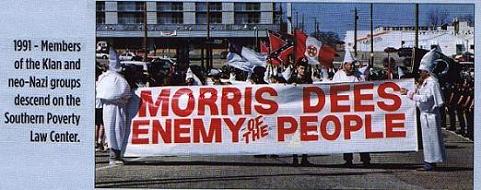
        The Southern Poverty Law Center was founded in 1971 by Morris Dees, a civil rights authority who has proven that the most effective way to fight criminal racists is to win convictions against them in civil court, rather than criminal court, where the burden of proof is much easier to achieve.  The villains may not go to jail, but the criminal penalties levied against them is enough to drive them out of business and persuade them to move on to more profitable ventures.  These pictures make it clear how much the villains hate Morris Dees and the SPLC:


        In 1983, in an attempt to detroy evidence gathered by the Center investigators for a major lawsuit against a Klan group, three Klansmen firebombed the Center's first headquarters (in Birmingham, Alabama).  Before the blaze, one arsonist tried to recruit a follower to assassinate Morris Dees. 
See much more about this great organization at www.SPLCenter.Org.

The Real ROSA PARKS

by Paul Loeb
Author of Book & website : Soul of a Citizen
        We learn much from how we present our heroes.  A few years ago, on Martin Luther King Day, I was interviewed on CNN.  So was Rosa Parks, by phone from Los Angeles.  "We're very honored to have her," said the host.  "Rosa Parks was the woman who wouldn't go to the back of the bus.  She wouldn't get up and give her seat in the white section to a white person.  That set in motion the year-long bus boycott in Montgomery.  It earned Rosa Parks the title of 'mother of the Civil Rights movement.'"
        I was excited to hear Parks' voice and to be part of the same show.  Then it occurred to me that the host's description - the story's standard rendition - stripped the Montgomery boycott of all its context.  Before refusing to give up her bus seat, Parks had spent twelve years helping lead the local NAACP chapter, along with union activist E.D. Nixon, from the Brotherhood of Sleeping Car Porters, teachers from the local Negro college, and a variety of ordinary members of Montgomery's African American community.  The summer before, Parks had attended a ten-day training session at Tennessee's labor and civil rights organizing school, the Highlander Center, where she'd met an older generation of civil rights activists and discussed the recent Supreme Court decision banning "separate-but-equal" schools.  During this period of involvement and education, Parks had become familiar with previous challenges to segregation: Another Montgomery bus boycott, fifty years earlier, successfully eased some restrictions; a bus boycott in Baton Rouge won limited gains two years before Parks was arrested; and the previous spring, a young Montgomery woman had also refused to move to the back of the bus, causing the NAACP to consider a legal challenge until it turned out that she was unmarried and pregnant, and therefore a poor symbol for a campaign.  In short, Parks didn't make a spur-of-the-moment decision.  Rosa Parks didn't single-handedly give birth to the civil rights efforts, but she was part of an existing movement for change, at a time when success was far from certain.  This in no way diminishes the power and historical importance of her refusal to give up her seat.  But it does remind us that this tremendously consequential act might never have taken place without all the humble and frustrating work that she and others did earlier on.  And that her initial step of getting involved was just as courageous and critical as her choice on the bus that all of us have heard about.
        People like Parks shape our models of social commitment.  Yet the conventional retelling of her story creates a standard so impossible to meet, it may actually make it harder for us to get involved.  This portrayal suggests that social activists come out of nowhere, to suddenly take dramatic stands.  It implies that we act with the greatest impact when we act alone, or at least when we act alone initially.  It reinforces a notion that anyone who takes a committed public stand, or at least an effective one, has to be a larger-than-life figure - someone with more time, energy, courage, vision, or knowledge than any normal person could ever possess.  This belief pervades our society, in part because the media tends not to represent historical change as the work of ordinary human beings, which it almost always is.
        Once we enshrine our heroes on pedestals, it becomes hard for mere mortals to measure up in our eyes.  However individuals speak out, we're tempted to dismiss their motives, knowledge, and tactics as insufficiently grand or heroic.  We fault them for not being in command of every fact and figure, or being able to answer every question put to them.  We fault ourselves as well, for not knowing every detail, or for harboring uncertainties and doubts.  We find it hard to imagine that ordinary human beings with ordinary flaws might make a critical difference in worthy social causes.
        Yet those who act have their own imperfections, and ample reasons to hold back.  "I think it does us all a disservice,"  says a young African-American activist in Atlanta named Sonya Tinsley, "when people who work for social change are presented as saints--so much more noble than the rest of us.  We get a false sense that from the moment they were born they were called to act, never had doubts, were bathed in a circle of light.  But I'm much more inspired learning how people succeeded despite their failings and uncertainties.  It's a much less intimidating image.  It makes me feel like I have a shot at changing things too."
        Sonya had recently attended a talk given by one of Martin Luther King's Morehouse professors, in which he mentioned how much King had struggled when he first came to college, getting only a 'C', for example, in his first philosophy course.  "I found that very inspiring, when I heard it,"  Sonya said, "given all that King achieved.  It made me feel that just about anything was possible."
        Our culture's misreading of the Rosa Parks story speaks to a more general collective amnesia, where we forget the examples that might most inspire our courage and conscience.  Apart from obvious times of military conflict, most of us know next to nothing of the many battles ordinary men and women fought to preserve freedom, expand the sphere of democracy, and create a more just society.  Of the abolitionist and civil rights movements, we at best recall a few key leaders - and often misread their actual stories.  We know even less about the turn-of-the-century populists who challenged entrenched economic interests and fought for a "cooperative commonwealth."  Who these days can describe the union movements that ended 80-hour work weeks at near-starvation wages? Who knows the origin of the social security system? How did the women's suffrage movement spread to hundreds of communities, and gather enough strength to prevail?
        As memories of these events disappear, we lose the knowledge of mechanisms that grassroots social movements have used successfully in the past to shift public sentiment and challenge entrenched institutional power.  Equally lost are the means by which their participants managed to keep on and eventually prevail in circumstances at least as harsh as those we face today.  As novelist Milan Kundera writes, "The struggle of man against power is the struggle of memory against forgetting."
        Think again about the different ways one can frame Rosa Parks' historic action.  In the prevailing myth, Parks decides to act almost on a whim, in isolation.  She's a virgin to politics, a holy innocent.  The lesson seems to be that if any of us suddenly got the urge to do something equally heroic, that would be great.  Of course most of us don't, so we wait our entire lives to find the ideal moment.
        Parks' real story conveys a far more empowering moral.  She begins with seemingly modest steps.  She goes to a meeting, and then another.  Hesitant at first, she gains confidence as she speaks out.  She keeps on despite a profoundly uncertain context, as she and others act as best they can to challenge deeply intrenched injustices, with little certainty of results. Had she and others given up after her tenth or eleventh year of commitment, we might never have heard of Montgomery.
        Parks' journey suggests that change is the product of deliberate, incremental action, whereby we join together to try to shape a better world. Sometimes our struggles will fail, as did many earlier efforts of Parks, her peers, and her predecessors.  Other times they may bear modest fruits.  And at times they will trigger a miraculous outpouring of courage and heart - as happened with her arrest and all that followed.  For only when we act despite all our uncertainties and doubts do we have the chance to shape history.
        Paul Loeb is the author of Soul of a Citizen: Living With Conviction in a Cynical Time (St Martin's, 1999, $15.95, www.soulofacitizen.org), and of Generation at the Crossroads, Nuclear Culture, and Hope in Hard Times.

The  "Christianity" of the "Bible Belt" of the United States of America:

        Frederick Douglass was an extraordinary man, who not only managed to throw off the shackles of slavery but went far beyond the conventional wisdom of his enslavers.  In his autobiography, he contrasted the Christianity that prevailed in the southern part of America at least in his day, and the Christianity of Christ :       " I find, since reading over the foregoing Narrative that I have, in several instances, spoken in such a tone and manner, respecting religion, as may possibly lead those unacquainted with my religious views to suppose me an opponent of all religion.  To remove the liability of such misapprehension, I deem it proper to append the following brief explanation.

F.Douglas         What I have said respecting and against religion, I mean strictly to apply to the slaveholding religion of this land, and with no possible reference to Christianity proper; for, between the Christianity of this land, and the Christianity of Christ, I recognize the widest, possible difference - so wide, that to receive the one as good, pure, and holy, is of necessity to reject the other as bad, corrupt, and wicked.  To be the friend of the one, is of necessity to be the enemy of the other.  I love the pure, peaceable, and impartial Christianity of Christ: I therefore hate the corrupt, slaveholding, women-whipping, cradle-plundering, partial and hypocritical Christianity of this land.  Indeed, I can see no reason, but the most deceitful one, for calling the religion of this land Christianity.  I look upon it as the climax of all misnomers, the boldest of all frauds, and the grossest of all libels.
        .  . .  I am filled with unutterable loathing when I contemplate the religious pomp and show, together with the horrible inconsistencies, which every where surround me.  We have men-stealers for ministers, women-whippers for missionaries, and cradle-plunderers for church members.  The man who wields the blood-clotted cow skin (whip) during the week fills the pulpit on Sunday, and claims to be a minister of the meek and lowly Jesus.  The man who robs me of my earnings at the end of each week  meets me as a class-leader on Sunday morning, to show me the way of life, and the path of salvation.  He who sells my sister, for purposes of prostitution, stands forth as the pious advocate of purity.  He who proclaims it a religious duty to read the Bible denies me the right of learning to read the name of the God who made me.  He who is the religious advocate of marriage robs whole millions (of slaves) of its sacred influence, and leaves them to the ravages of wholesale (moral) pollution.  The warm defender of the sacredness of the family relation is the same that scatters whole families, - sundering husbands and wives, parents and children, sisters and brothers, leaving the hut vacant, and the hearth desolate.  We see the thief preaching against theft, and the adulterer against adultery.  We have men sold to build churches, women sold to support the gospel, and babes sold to purchase Bibles for the poor heathen! all for the glory of God and the good of souls!  The slave auctioneer's bell and the church-going bell chime in with each other, and the bitter cries of the heart-broken slave are drowned in the religious shouts of his pious master.  Revivals of religion and revivals in the slave-trade go hand in hand together.  The slave prison and the church stand near each other.  The clanking of fetters and the rattling of chains in the prison, and the pious psalm and solemn prayer in the church, may be heard at the same time.  The dealers in the bodies and souls of men erect their stand in the presence of the pulpit, and they mutually help each other.  The dealer gives his blood-stained gold to support the pulpit, and the pulpit, in return, covers his infernal business with the garb of Christianity.  Here we have religion and robbery the allies of each other - devils dressed in angels' robes, and hell presenting the semblance of paradise."
        " I assert most unhesitatingly, that the religion of the South is a mere covering for the most horrid crimes - a justifier of the most appalling barbarity, a sanctifier of the most hateful frauds, and a dark shelter under which the darkest, foulest, grossest, and most infernal deeds of slave holders find the strongest protection. "
        "Were I to be again reduced to the chains of slavery, next to that enslavement, I should regard being the slave of a religious master the greatest calamity that could befall me...  I hate the corrupt, slave holding, women-whipping, cradle-plundering, partial and hypocritical Christianity of this land."
      - Frederick Douglass (After the Escape)

So boycott, already!

        The wonderful comic, Sam Levinson, had a great answer for anti-Semites.
"It's a free world and you don't have to like Jews, but if you DON'T,
I suggest that you boycott all Jewish products, like:
  • Digitalis,     discovered by Doctor Nuslin,
  • Insulin,   discovered by Doctor Minofsky,
  • Chloral Hydrate,   discovered by Doctor Lifreich,
  • The Schick Test   for Diphtheria,
  • The Wasserman Test   for syphilis,
  • Vitamins,   discovered by Doctor Funk,
  • Streptomycin,   discovered by Doctor Woronan,
  • The Polio Pill   by Doctor Sabin and
  • The Polio Vaccine  by Doctor Jonas Salk.
        Humanitarian consistency requires that my people offer all these gifts to all people of the world. Fanatic consistency requires that all bigots accept Diabetes, Convulsions, Malnutrition, Infantile Paralysis, Syphilis and Tuberculosis as a matter of principle.
        Be mad at us, if you like! Go on, boycott!  But I'm telling you it ain't gonna feel so good."

While many white Americans fear being harmed by black people, history
shows that they have much more to fear from fellow whites, people like :

Ted Bundy (serial killer) Ted Kuzinski (serial bomber)
John Wayne Gayce (serial killer) Geoffrey Dahmer (serial killer)
Richard Speck (serial killer) "Army of God" (serial killers)
Charles Manson (serial killer) All of Manson's murderous followers
Timothy McVeigh (mass murderer) Terry Nickles (McVeigh accomplice)
And let's not forget the world's greatest
mass murderers of them all,
the likes of Hitler and Stalin!
In contrast to these there have been few
attacks by Blacks on Whites in America :
One lone gunman's attack on Long Island train
and the relatively minor attacks of the Black Panthers.
To those who claim "Affirmative Action" is racist, we counter :
        Being aware of the differences among the races is not "racism".  Such awareness is natural and inevitable.  The goal isn't to be oblivious to racial differences - which is impossible, unrealistic and pointless. -   The kind of "racism" that needs to be condemned and avoided is unfair or unjustified partiality for or against people simply because of their race.  Society cannot redress the inequities that are the current effects of past racism, unless and until it exercizes fair partiality towards the victims of that racism, which it can only do IF it can recognize those victims.
Ray Dubuque

Contact  
email image
[email protected]
There is much more where this came from, at Liberal insights
and/or
Liberals Like Christ

Web discoveries