Having covered in Section One the way in which the church prepared the soil and sowed the seeds for the Jewish holocaust for centuries leading up to it, this second of four sections deals with the help which Catholic churchmen gave to the Nazi mass-murders during the holocaust:
Protestant Shame :
|
The founder of the Lutheran Church, Martin Luther, was a virulent anti-semite much quoted by Hitler. In fact, the Nazis scheduled their "Crystal Night" purge in honor of Martin Luther's birthday! But Catholics shouldn't be too quick to point a finger at Luther's anti-semitism, because he didn't invent it; he developed it in the arms of his mother, the Roman Catholic Church in which he was raised, educated and ordained as an Augustinian monk. Although he "protested" against many of the Catholic Church's beliefs and practices, one belief he embraced rather than rejected was the Catholic Church's contempt for the Jews. For more on Luther, see my Luther and the Holocaust.
"In December 1941, Protestant Evangelical Church leaders of seven regions of Germany collectively issued an official proclamation that declared the Jews incapable of being saved by baptism, owing to their racial constitution; to be responsible for the war; and to be 'born enemies of the world and Germany.' They therefore urged that the 'severest measures against the Jews be adopted and that they be banished from German lands.' Would not the superlative the 'severest measures' encompass the death penalty? And with the context of the apocalyptic war with the Soviet Union and of the Germans' already ongoing extermination of Soviet Jewry, it could have meant only one thing. With these words, the Protestant Church leadership of a good part of Germany-collectively as a corporate group, and with the authority of their offices-on their own initiative implicitly endorsed the mass slaughter of Jews or at least knew that many would understand them to be endorsing the annihilation, which amounts to the same result.
If Christian antisemitism could motivate Church leaders to support the slaughter of Jews, then it could, and did, certainly motivate many lay Christians across Europe to do the same."
{from A Moral Reckoning, by Daniel Goldhagen, p. 166 }
In the end neither the official Protestant or Catholic churches tried to stem the tide of anti-Semitic measure taken by the Nazis, The Kirchliches Jahrbuch summarized it (the Protestant response) after the war: :
"The anti-Semitism of the NSDAP found the Evagelical church unprepared. Indeed, at least the Confessing church resisted the Aryan paragraph in the church and the separation of Jewish Christians out of the Evangelical church of Germany, but against anti-Semitism they uttered no word, and even at the time of the Jewish persecutions and of their extermination it could not bring itself to stand against the measures of the National Socialist regime both in and without the church." [Helmreich, p. 332]
Here is a good example, i.e. the Protestant churches response to this oppression of Jews who had converted to their own Christian faith. On December 17, 1941, Protestant Evangelical Church leaders of Mecklenburg, Thuringia, Saxony, Nassau-Hesse, Mecklenburg, Schleswig-Holstein, Anhalt, and Lubeck collectively issued an official proclamation:
"From the crucifixion of Christ to the present day, the Jews have fought Christianity or misused and falsified it in order to reach their own selfish goals. By Christian baptism nothing is altered in regard to a Jew's racial separateness, his national being, and his biological nature. A German Evangelical church has to care for and further the religious life of German fellow countrymen; racial Jewish Christians have no place or rights in it." [Helmreich, Ernst Christian, The German Churches under Hitler: Background, Struggle, and Epilogue, Wayne State University Press, Detroit, 1979 Helmreich, p. 329]
"Betrayal: German Churches and the Holocaust" is a collection of essays by various scholars with expertise in this matter, largely about the failures of the Protestant churches in Germany to respond appropriately to the Nazi Holocaust. It was edited by Robert Ericksen and Susannah Heschel. There are several excerpts further down on this page.
"Whereas the Catholic Church was often treated as an enemy in the Nazi state, the Protestant churches were treated, in the main, significantly better. In Dachau, the primary destination for priests and pastors persecuted by the Nazis, 447 German clergymen were interned: 411 were Catholic, 36 Protestant. When the numbers of these clergymen are further broken down, the disparity becomes even greater:
- 8 Catholics executed, no Protestants;
- 3 Catholics sentenced to death, no Protestants;
- 47 Catholics sent to concentration camps, 2 Protestants;
- 99 Catholics imprisoned, 8 Protestants;
- 163 Catholics detained, 24 Protestants." (p. 159)
[from an article by Richard Steigmann-Gall, entitled "Religion and the churches" in the book NAZI GERMANY, by Jane Caplan
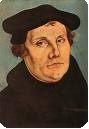 |
"Failing to Preach the Gospel" Martin Luther's life was one of great turmoil. The following shows him at his best: |
|
Luther: "The church that preaches the gospel in all of its fullness, except as it applies to the great social ills of the day, is failing to preach the gospel."
�Would that the Lutherans (and Catholics) of the Third Reich had been exposed to the following profoundly important exchange with one of his followers whom he urged to trust the ethics of the gospel rather than the threats from his war-making government: | |
For much more on the deplorable conduct of the majority of Protestant church leaders during the Nazi era, see
hist.academic.claremontmckenna.edu
/jpetropoulos /church/keithpage/protesta.htm
Roman Catholic Shame:
- The R.C. Church had a very centralized structure and a very powerful presence not just in Germany, but in every country in the world, enabling it to know much better than just about any organization in the world, what was going on throughout Europe and giving it more power than any other moral institution in the world to hinder, if not totally stop, the mass-murder of millions of innocent human beings, including Roman Catholics.
- The R.C. Church had a very powerful political party at its command in Germany. Hitler wasn't able to get the dictatorial powers he was seeking in 1933 until he persuaded the future Pope Pius XII to use his influence to disband that party and get many of its members to support the Nazi Party..
- The R. C. Church wasn't just a bystander of the Nazi hatred of the Jews. This church had dominated most of western Europe during the 17 centuries since the conversion of Constantine, and during most of that time the church had promoted contempt for the Jews, as we demonstrate in CatholicArrogance.Org/Catholic/RC_scandal-1.html.
- Although Catholics have been trying to put distance between their church and Hitler since his demise, the fact is that many of those whom Hitler put in charge in the Third Reich were like himself Roman Catholics. Adolf Hitler was brought up as a very devout Catholic, and even though he outgrew that church in many respects, he retained many of its beliefs, and found it to his political advantage to maintain to the bitter end his reputation as a Catholic "in good standing". See a great deal of documentation on this important issue at CatholicArrogance.Org/Hitlersfaith.html.
- Almost all of the leaders of the other European nations that made up the NAZI "Axis" powers were Roman Catholics, and two were actually priests! See more detail on this important issue at http://CatholicArrogance.Org/NaziLeadership.html .
- The R. C. Church is both the largest and one of the most arrogant of all the religious bodies of the world, claiming to be the "one, true church", "outside of which there is no salvation", the only one claiming to have Christ's personal "vicar" as its head. If it is going to make such extravagant claims, shouldn't it be a model of extraordinary holiness, rather than an example of shameful compliance with evil incarnate?
- The R. C. Church is constantly lecturing to others, as though it is entitled by its supposedly superior grasp of and devotion to morality to tell women, for example, that they have no right to use "artificial means" to avoid pregnancies, no right to terminate pregnancies once begun, or to tell people who don't have any desire to spend their lives in a permanent relationship with a person of the opposite gender, that it is immoral for them to want to spend their lives in a permanent relationship with a person of the same gender. Is this church's claim to moral superiority justified?
Furthermore, I have two additional personal reasons for having a special interest in the behavior of the Roman Catholic Church :
- I was born into a very pious R. C. family, was nurtured for some 24 years in Catholic schools and seminaries under the shadow of Pope Pius XII, and became a priest and seminary professor under his successor, Pope John XXIII. Having invested so much of my life in this church, I know it well and have a great deal of interest in it.
- Although I left the Catholic Church, when Pope Paul VI, who had been Pius XII's right hand man showed that the church was back in the hands of those intent on returning the church to the dark ages, I continue to have a great many relatives and a great many friends and neighbors who are Catholics. So, to the extent that "the Catholic Church" is its people, there's no question that even while finding fault with some in the highest places in the hierarchy, I still love "the Catholic Church", i.e. a great many of its members.
Catholic Leadership Support for Third Reich
Many Roman Catholics who haven't read anything objective about the period imagine that, if they had been in Germany at the time of the Holocaust, they would have naturally been inspired by their church leaders to oppose Hitler and his murdering NAZI administration. But they do so without any evidence to support that view. Since Roman Catholics comprised a larger portion of Germany's population in the 1930's, than they do in the United States today, i.e. about 33% of Germans, vs. 25% of Americans, that would have had quite an impact on Germany's policies. Roman Catholics also comprised at least a third of NAZI Germany's army, police, public servants, railway workers and prison guards, etc., etc., More importantly, however, the cohesion they possessed through their union with Rome and with each other gave them tremendous political strength, which was manifested at the time through their very own political party, which didn't have the power to rule the country itself, but often did have the power to determine which other party did.
Austria, on the other hand, was much more Catholic, and when Hitler wanted to swallow up his native country into Germany, in 1938, 5 years after the Nazis had revealed their worst tendancies - short of killing the Jews - here are the Austrian bishops' own words translated from German, and included as an exhibit at the Nuremberg Military Trials:'Solemn Declaration [ the articles below were provided by Ray Dubuque to illustrate the incongruity about which Franz wrote.]We, the undersigned bishops of the Austrian episcopate, on the occasion of the great historical events in Deutschoesterreich [German Austria], out of our innermost conviction and of our own free will, declare the following:
We recognize with joy that the Nationalist Socialist (i.e. "Nazi") movement has produced outstanding achievements in the spheres of national and economic reconstruction, as well as in their welfare policy for the German Reich and people, and, in particular, for the poorest strata of the people. We are also convinced that, through the activities of the National Socialist movement, the danger of all-destroying godless bolshevism was averted.
The bishops accompany these activities with their sincerest blessings for the future, and shall also exhort the faithful accordingly. On the day of the plebiscite, we bishops consider it our obvious national duty, as Germans (NOT Austrians), to profess our loyalty to the German Reich, and we also expect all faithful Christians to know what they owe to their people. Vienna, 18 March 1938.Adam Hefter, Fb. [ Translation of document krauch 92, General Defense exhibit 147' ]
Th. Cardinal Innitzer Eb.
Fer. Pawlikowski Fb.
S. Waitz, F.Eb.
Miehael Memelauer
Johannes Maria PfoellnerHow many people know that the very day the Japanese were bombing Pearl Harbor, "a day that will live in infamy", the New York Times reported the following "War Prayer for Reich - Catholic Bishops at Fulda Ask Blessing and Victory"? (I'm not arguing that the two events were connected. It's just an interesting coincidence. Roman Catholics in America may not have noticed the article below, ( perhaps because it was buried on page 33, or because of the Japanese distraction in Hawaii ), but you can be sure that this message was heard loud and clear by the Catholics of Germany , who were already obeying orders to hunt down those men, women and children neighbors of theirs who happened to be Jewish in order to ship them to concentration camps, and who would soon be killing their fellow Roman Catholics from the allied nations, as well !
Don't take my word for it. Read the original prayers to the right, of the Roman Catholic hierarchy urging their followers, and God Almighty, to do all that they could to assure Hitler's success.
Dec. 7, 1941 (page 33)
WAR PRAYER
---------------------------------------------------------
FOR REICH
Catholic Bishops at Fulda
Ask Blessing and Victory
------------------------------------------------------by telephone to the New York Times.
Fulda, Germany, Dec. 6 - The (annual) conference of German Catholic Bishops assembled in Fulda has recommended the introduction of a special "war prayer" which is to be read at the beginning and end of all divine services.
The prayer implores Providence to bless German arms with victory and grant protection to the lives and health of all soldiers. The Bishops further instructed Catholic clergy to keep and remember in a special Sunday sermon at least once a month German soldiers "on land, on sea and in the air."
The German Catholic clergy, while strongly objecting to certain aspects of NAZI racial policy, has always taken care to emphasize the duty of every Catholic to his country as loyal Germans in the present war.
Transcribed verbatim and in full
(for better legibility) from
microfiche copies of the originalsOne might wish and/or imagine that statements such as the above were the exception leading up to and during World War II in Germany. But History shows that they were not; they were the rule. For decades the Catholic bishops of Germany had been meeting at centrally located Fulda for several days each year to make national policy decisions and often to make policy statements. In the early 1930's, the German hierarchy forbade Catholics from joining the Nazi Party. But all of that changed when Papal Nuncio Pacelli, the future Pope Pius XII, and Hitler agreed on the fateful Reich Concordat of 1933. If, at any time between 1933, when he became Chancellor and his death in 1945, Hitler had considered the annual gathering of Germany's bishops at Fulda a threat he would surely have had them stopped. Yet, even when the Nazis were at their worst in Germany, in 1943, the bishops continued to meet. And the most they managed to do that fateful year was to consider speaking out about the Holocaust and confronting Hitler with a direct accusation. Under pressure from Pius XII, it appears, they decided against such bold action.
"A few days after the Anschluss, the Nazi take-over of Austria, the senior Catholic primate, Cardinal Innitzer, incredibly ordered the bells of all Austria�s churches to be rung as a special welcome for Adolf Hitler, and agreed to hoist a swastika on the top of St Stefan�s Cathedral, something that had never happened even in Germany. And all this, while unheard-of brutalities against Jews were daily being perpetrated in the streets, of which Innitzer was perfectly aware."We have also since learnt that in 1943, when the wagons from Slovakia were rolling to Auschwitz, the Final Solution being then in full swing, the Jews of Slovakia, in desperation, sought audience with the Archbishop of Bratislava, to try to persuade him to intervene to stop the deportations, only to be told that he could not intervene, since the Jews were going to their inevitable fate, as foretold for two thousand years." [ taken from an unsourced website.]
Pope Pius XII's ambassador at the annual birthday party
thrown for Hitler by Germany's R.C. hierarchy :On April 20, 1939, (Archbishop) Orsenigo was Pope Pius XII's official representative at Adolf Hitler's birthday celebration, a tradition initiated by Pope Pius XII, when he preceded Orsenigo as Papal Nuncio to Germany. Each year, in the name of the Catholic bishops and the dioceses in Germany, April 20, Cardinal Bertram of Breslau sent "warmest congratulations to the Führer, with "fervent prayers which the Catholics of Germany are sending to heaven on their altars."
. (Source: Hitler's Pope: The Secret History of Pius XII, by John Cornwell)This same head of the German Bishops' Conference, Cardinal Bertram, opposed all public protests against the deportation and massacre of the Jews.
See also Hitler's Priests: Catholic Clergy and National Socialism
by Father Kevin P. Spicer, C.S.C.
(Northern Illinois University Press in association with
the United States Holocaust Memorial Museum, 2008,and a whole site devoted to pictures of R. C. "High Priests"
hobnobbing with Nazi leaders at :
www.nobeliefs.com/nazis.htm.
When the German-speaking American sociologist, Gordon C. Zahn, went to Germany in the 1950's, in the hope of finding evidence of resistance on the part of his Roman Catholic Church to the NAZI regime, he was astounded to learn that it took little more than one hand to count the number of Roman Catholics who had refused to be good patriots and to serve in Hitler's armed services! And far from being inspired by their Catholic church to "resist evil", several of these heroic conscientious objectors, which included at least one priest, were actually refused the sacraments on the grounds that their refusal to cooperate with the NAZI government was proof that they were bad Catholics!
"Despite repeated inquiries among the chancery officials and Catholics who had been active in the pre-Hitler peace movement, the writer (Zahn) was able to learn of no more than seven Catholics who openly refused military service. Six of these men were executed for their refusal. The seventh, charged with a capital offense, was fortunate enough to escape death only by being placed in indefinite custody in what one informant described as a military mental institution."In 2007, one of these, Franz Jagerstatter, was "beatifed" by the Vatican, the step that leads to "canonization", whereby a person is declared a saint. What few of the hierarchy of his church were able to fathom at the time Franz formulated very clearly in a letter from prison to his wife, "Can there be any talk of defense of the Fatherland when one invades countries that owe one (i.e. Germany) nothing and robs and murders there? What more can we Catholic Austrians lose if we fight no further for the German state? ... That we Catholics must make ourselves tools of the worst and most dangerous anti-Christian power that has ever existed is something I cannot and never will believe."
See http://ncronline.org/NCR_Online/archives2/2007d/110907/110907a.htm .
Looking back on this period, the devout Roman Catholic sociologist, Gordan Zahn, came to the heart-wrenching but honest conclusion:Hitler greeting Catholic Abbot Schachleitner
and Protestant "Bishop of the Reich" Muller
"The (ordinary) German Catholic supported Hitler's wars not only because such support was required by the NAZI ruler but also because his religious leaders formally called upon him to do so; not only because the actions and opinion of his fellow citizens made him feel obligated to share the nation's burdens and sorrows but also because, by example and open encouragement, the Catholic press and Catholic organizations gave their total commitment to the nation's cause; not only because of deep-felt fears of the terrible price (that) nonconformity would bring or the warm surge of satisfaction accompanying nationalistic or patriotic identification with the war effort, but also because his most cherished religious values had been called into play to encourage him to take his post 'on the field of honor' 'in the defense of Volk and Vaterland.' (the people and the fatherland) " ( p. 56) , and
"The German Catholic who looked to his religious superiors for spiritual guidance and direction regarding service in Hitler's wars received virtually the same answers he would have received from the NAZI ruler himself." { German Catholics and Hitler's Wars, p. 17 )
"What about the hundreds of German priests serving the German army and occupation forces in eastern Europe, who were in the thick of killing operations, holding services for and hearing the confessions of the killers? Did they see Jews as innocent and the mass slaughtering of Jews as wrong? Did the priests tell the many Catholics among the hundreds of thousands of Germans participating in the mass annihilation that they were sinning? The evidence strongly suggests that they did not. If they had viewed the killing of the Jews as a crime and a sin, then we would in all likelihood know about such a view and of their initiatives among the perpetrators, because it has been the practice of the Church to put forward any evidence that would cast a favorable light upon itself. The testimony that does exist is not heartening. Of an estimated one thousand Catholic and Protestant clergy serving as military chaplains, fewer than ten cases (most are Catholic priests) have come to light - some of which are dubious - where it can be said that the chaplains conveyed disapproval of or urged resistance to the mass murder. . .
That Catholic priests in the thick of the mass murder greeted the annihilation of the Jews with silence or worse should come as no surprise, since the Catholic military bishop, Franz Justus Rarkowski, the spiritual leader of the priests assigned to the Wehrmacht, was deeply Nazified." ( Moral Reckoning, pp.62-63)
. . . the great majority of German military chaplains, Catholics and Protestants, "weighed in on the side of the perpetrators, condoning and blessing their crimes through words, actions, and silence. One of the most obvious manifestations of this function was the provision of group absolution for soldiers."
How could we not maintain that the German priests who gave succor to the genocidal executioners were at least collaborators with the Nazi regime, if not partners in this mass-murdering onslaught? Why did the Pope not instruct them to counsel all Catholics among the executioners that they must stop murdering Jews? This virtually unknown and unmentioned chapter of the Catholic Church and its clergy's role in the Holocaust has barely been investigated." ( Moral Reckoning, pp. 62-63)
If only Roman Catholics today would identify with the 10 million innocent Jews and other NAZI victims, (with whom they share humanity itself) instead of identifying with the Catholic clerics ( with whom they only share denominational beliefs), they might be more willing to look at the evidence objectively. It is such a shame that such people get angry with scholars like John Cornwell, James Carroll, Peter DeRosa and Gordon Zahn, all of whom are Catholics, and all of whom are simply doing their job of studying and publicizing truth. Rather than get upset with those self-proclaimed "men of God" who praised and supported Hitler, such Catholics identify with them, and condemn those who are at long last exposing that shameful behavior. Why do such people care so much more about a few clerics, who only stand to lose their reputations, than they do about the millions of innocent men, women and children who were unjustly deprived of everything that they were entitled to in this life, including their very lives, and those of most of their relatives?
Guenter Lewy devoted an entire chapter to his explanation of why the German hierarchy supported Hitler's administration, despite all their reservations about it. The following is his excellent summary of that outstanding chapter:
" In February 1940 Archbishop Grober directed a lengthy letter to the Reich Defense Council in which he protested against these aspersions and reaffirmed the dedication of the Catholics to the national cause. The Church, he wrote, at the beginning of the war had taken steps to effect a truce, but certain elements on the other side were unwilling to honor it. Two months later, on the occasion of Hitler's birthday, April 20, 1940, in the name of the episcopate Cardinal Bertram congratulated the Reich Chancellor and Führer. The "most cordial felicitations" of the bishops, Bertram wrote, go to the Führer, together with the "fervent prayers which on April 20 the Catholics of Germany send to heaven from the altars for people, army, fatherland, for state and Führer." The German Catholics, Bertram insisted, contrary to the thinking of certain circles, were fully loyal and merely wanted to maintain Germany in the Christian faith. Only thus could the necessary strength be mustered successfully to conclude (win) the war. Bertram ended his letter with the request that Hitler not take offense at this pleading for the rights of the Church, but regard it as "inseparable from the sincere wishes which the supreme pastors of millions of your subjects cherish for people and fatherland, for state and Führer."
During the following years, and until Germany's military collapse in 1945, the bishops periodically protested the regime's nonobservance of the truce that was supposed to prevail between Church and State. Whenever members of the episcopate criticized specific measures of the state, they hastened to add that these criticisms should not give comfort to the enemy or weaken the inner front. The joint pastoral letter of the Cologne and Paderborn church provinces of March 1942, which reaffirmed the natural rights of life, liberty and property, and decried the arbitrary detention and killing of innocents, ended with the following typical admonishment to the faithful:
" That which we bishops had to tell you today with grievously moved soul may not however serve anyone as an excuse to neglect his national duties. On the contrary! With the full authority of our holy office we urge you again today: In this time of war fulfil your patriotic duties most conscientiously! Don't let anyone surpass you in willingness to make sacrifices and readiness to do your share! Be faithful to our people ! "
The Church, declared Bishop Landersdorfer in December 1941, supported the struggle against Bolshevism and hoped that it would be possible "once and for all to render this pest harmless." Even though, as the Bishop observed, it was difficult to avoid the impression that the help of the Church in this war was not at all welcomed by the government, the Catholics, despite all harassment of the Church, had to continue serving their people. The Nazis were biding their time, impatiently waiting for the day on which they could afford to settle final accounts with the Church. Reacting to a memorandum of Cardinal Bertram, Goebbels wrote in his diary on May 16, 1943: "I could just burst with rage when I think that we cannot possibly call the guilty ones to account now. We shall have to save our vengeance until later." The Church, for her part, honored the truce, and in the event of a German victory would undoubtedly have invoked with pride her services to the war effort. When Germany lost the war, the Church could point to her many protests against specific acts of wrongdoing and to the fact that she had been persecuted by the Nazi state. Unhappily this persecution had nothing to do with the Church's attitude to Hitler's wars, which the Church supported wholeheartedly. In fact, much of the regime's hostility was due to the desire to get rid of an unwanted ally whom the Nazis intended to destroy as a force in Germany as soon as the war was over. ( Lewy, pp. 256-257 )
A priest who is a member of the Congregation of the Holy Cross, Father Kevin P. Spicer, , (Northern Illinois University Press in association with the United States Holocaust Memorial Museum, 2008, 369 pp.).
The Jews of Rome :
A relatively small number of Jews were killed, 1900, but their annihilation is especially tragic, as is demonstrated by the name of one of the important books published about the role of the papacy in the holocaust, Under His Very Windows: (The Vatican and the Holocaust in Italy), by Susan Zuccotti (2000 A.D.)
Zuccotti came to the following conclusions (among many others):
"There were in Rome in 1943 and 1944 hundreds of parish churches, 1,120 religious institutions for women, and 152 for men. Given that surprisingly large number, the statistics of 100 female convents and 55 male institutions (including eleven parish churches) that sheltered Jews becomes less impressive. Most Catholic institutions, after all, took pride in their reputation as dispensers of hospitality and succor. It should have been the norm rather than the exception for them to shelter Jews and others in distress. Perhaps more did, but perhaps not. What is certain is that we will never really know" (Zuccotti, p. 201)
"This book has made it clear that the pope did not welcome Jews in the Vatican". (Zuccotti, p. 253).
"Pius XII personally seems to have made no contacts and no appeal to the Italians for the Jews. Likewise, he seems never to have appealed personally to any German officials. At the very least, he might have asked that Italian Jews might be allowed to remain in internment on Italian soil. He did not do so" (Zuccotti, p. 294).
In his chapter on the beginning of the tribulations for the Jews of Rome, John Cornwell explains that the trucks carting the Jews off to their deaths were driven right past St. Peter's square, so that the Roman Catholic soldiers on them could see the famous center of Catholicism. He also shows that contrary to the figment that Pope Pius XII had to fear NAZI retribution against him and his church, the German occupiers themselves didn't want to move against the Jews of Rome, because these German occupiers feared the reaction of the Italian Catholic population, which was very sympathetic to the Jews. Pope Pius refused to intervene on behalf of the Jews of Rome even though the leadership of the German occupation itself was urging him to protest publicly and to register his objections with Berlin.
Instead, five days later this entry appears in the meticulously kept log at Auschwitz: "Transport, Jews from Rome.
After the selection 149 men (registered with numbers 158451-158639) and 47 women (registered with numbers 66172- 66218) have been admitted to the detention camp. The rest have been gassed."
Another misunderstanding that Cornwell clears up here is the role of the chief Rabbi of Rome at this time. Israel Zolli has been used since then as a great apologist for Pope Pius XII. When Catholics quote Zolli and point out that he became a convert to Roman Catholicism, look to see if they also reveal that this so-called "chief rabbi of Rome" was disowned by the Jews (i.e. practically "defrocked") for abandoning his community at their time of greatest need, while accepting the hospitality of Pius XII for himself and his immediate family within the walls of the papal residence, a palace with eleven THOUSAND rooms(sic), more than enough to hide every last one of the 1900 Jews of Rome.
The Jews of Croatia :
The deniers of the Catholic Church's complicity in the holocaust are so numerous that there is barely a Roman Catholic in a million, no matter how educated, who is even aware of the atrocities perpetrated in the Roman Catholic country of Croatia in the name and under the leadership of their own Catholic hierarchy, and the full knowledge and approval of the Vatican during World War II.
Although a puppet of Hitler, Ante Pavelic, the dictator of Catholic Croatia, once chided Hitler on a visit to Berlin about his `lenient' treatment of German Jews, boasting that in comparison he had completely solved the Jewish question in Croatia, while some Jews remained alive in Hitler's Third Reich.
This is such an important and unknown area of the Catholic Church's complicity in the Holocaust that we devote an entire web chapter to it at CatholicArrogance.Org/CroatianHolocaust.html.
Hitler's Mein Kampf never put on the "Index of Forbidden Books"
Because Adolf Hitler and so many of the other Nazi leaders were Roman Catholics, and it was important to them to be viewed as such by the citizenry of their Christian nations, the leadership of the Roman Catholic Church had several powerful tools it could have used to influence them, namely, the threat of excommunication, denial of access to the public sacraments, and the placement of the Nazi bible, Hitler's "Mein Kampf" on the "Index of Forbidden Books". That famous list of banned books is now defunct, but it was very much in use in those times. In the recent 19th century 1,359 "dangerous works" had been thus censured.
The following are excerpts from the Amazon.com editorials about Adolf Hitler's "Mein Kampf" (which means "My Struggle").
"As Hitler's power increased, pressure was put on all party members to buy the book. Gradually this pressure was extended to all elements of the German population. Soon Mein Kampf was even being passed out to newlywed couples as a gift. Ironically, and frighteningly, by the time Hitler came to power on January 30, 1933, what has been considered by many to be the most satanic book ever written was running neck and neck with the Bible at the top of the German bestseller lists."
In his excellent introduction to this definitive American translation of Mein Kampf, Konrad Heiden writes: "For years Mein Kampf stood as proof of the blindness and complacency of the world. For in its pages Hitler announced - long before he came to power - a program of blood and terror in a self-revelation of such overwhelming frankness that few among its readers had the courage to believe it. . . That such a man could go so far toward realizing his ambitions, and - above all - could find millions of willing tools and helpers; that is a phenomenon the world will ponder for centuries to come."
Alfred Rosenberg, who was the head of Hitler's Nazi ideological education published a book entitled "Myth of the Twentieth Century" which the Vatican found objectionable enough to be put on the Index. He proved that it was still possible to get the church upset enough to get that distinction.
As for the threat of excommunication or denial of access to the public sacraments, during the "Kulturkampf", just 50 years earlier, the church had declared that priests who cooperated with Chancellor Bismarck against the Catholic Church were automatically excommunicated. Shortly after WW II, Pope Pius XII declared that any Catholic in Italy who joined the Communist party, even if they did nothing further, were ipso facto excommunicated. Pius XII also used that sledge hammer a little later to crush the liberal "Worker Priest" movement in France. At the same time, the Vatican was working "underground" to get some of the worst Nazi war criminals out of Europe, providing only that they be "Catholics". The Nazi dictator of Slovakia was not only a Catholic, but a priest, named Doctor Monsignor Tiso. Tiso was not harassed by Pius XII either during the Holocaust or afterwards. When Cardinal Stepinac was convicted on war crimes against innocent non-Catholics, largely on the testimony of his Catholic countrymen, instead of taking action against the disgraced churchman - whom he had supported along with his good friend, the mass-murdering Ante Pavelic, Pope Pius XII excommunicated the truth-telling witnesses !
Defenders of Pius XII claim that he was wise not to play "the excommunication card" because it probably wouldn't have worked, as the Catholic population might have rallied to Hitler, or it might have made matters worse for either the Catholic Church or even the Jewish victims.
The trouble with these excuses is that the excommunication option wasn't set aside in favor of some better option. As James Carroll pointed out in Constantine's Sword,
"Even an indirect endorsement meant everything to Hitler as he sought to establish his legitimacy at home and abroad. In these early months of 1933, Catholic leaders went from being Hitler's staunch opponents to his latest allies. This transformation was dramatically symbolized by the fact that in 1932, the Fulda Episcopal Conference, representing the Catholic hierarchy of Germany, banned membership in the Nazi Party" and forbade priests from offering communion to anyone wearing the swastika; then, on March 28, 1933, two weeks after Pacelli offered his overture to Hitler, the same Fulda conferees voted to lift the ban on Catholic membership in the Nazi Party. The bishops expressed, as they put it, 'a certain confidence in the new government, subject to reservations concerning some religious and moral lapses.' Swastika bearers would now be welcomed at the communion rail. [p. 498]This policy was a complete repudiation of an important provision of the Roman Catholic Church's "Code of Canon Law", i.e. Canon # 915, which the Conservative Church of the last century couldn't manage to invoke against Nazi Catholics political leaders in Germany, but which Conservative Republican Catholics in the U.S.A. have been urging the Church to invoke against today's Liberal Democratic Catholic politicians in America.
In 1955 Pope Pius XII himself proved how effective a tool excommunication could be when he used it on the Argentine dictator,Juan Peron for jailing several priests and nuns who had objected to his abusive rule. In just three months Peron's regime collapsed and he had to flee the country in fear of his life, never to return.Here are the findings of the book, "Betrayal:German Churches and the Holocaust", by Ericksen and Heschel:
" Secular historians tend to ignore churches, as well as Christian teachings, in their attempts to explain the relation between the German people and the Nazi regime. This book assumes, by contrast, that the Christian component in Nazi Germany is worthy of careful consideration. A few figures help clarify the picture. The German census of May 1939 indicates that 54 percent of Germans considered themselves Protestant and 40 percent considered themselves Catholic, with only 3.5 percent claiming to be neo-pagan "believers in God," and 1.5 percent unbelievers.' This census came more than six years into the Hitler era. Both Catholic and Protestant churches remained official state churches throughout the Nazi regime, which meant that the state collected a church tax and funded church expenses. Religious education remained a part of the state education system, chaplains served the military, and theological faculties remained funded and active within the state universities. Article 24 in the Nazi Party Program always professed "positive Christianity" as the foundation of the German state.
Clearly, the Nazi regime had no real sympathy for Christianity and little use for theologians, but we may still ask how the churches themselves experienced the regime. Certainly, Hitler's effort to separate church from state was perceived correctly by many church leaders as an effort to reduce their power and influence, yet the separation of church from state is hardly an act of persecution. In 1936, when the Nazi Party demanded that the swastika be removed from church newspapers and from church altars, there were loud protests from church leaders. Pastors who had placed the swastika on the altar, next to the cross, claimed the swastika was a key element in the religious life of their congregants. Church officials who placed the swastika on the masthead of their church newspapers meant thereby to proclaim their support for the regime. At the time, the Nazi policy prohibiting church use of the swastika was most likely experienced as an act of persecution, denying churches full participation in the life of the Third Reich. Yet this is hardly the persecution that church leaders complained of in the postwar years. For historians seeking to evaluate the churches' intentions, the important point is that the church itself did not forbid the swastika.
Did the churches only pretend to be enthusiastic supporters of National socialism in order to protect themselves? If the churches had truly been persecuted victims, we might expect to have heard a cry of relief when the war ended and Hitler came to his had end. By the summer of 1945, we would expect to have seen church proclamations vehemently denouncing Nazism and condemning the murder of the Jews. But we do not. This silence is one strong indicator of the attitudes held during previous years.
As subsequent chapters indicate, there were many enthusiastic supporters of National Socialism in both the Catholic and Protestant churches. Conversely, there were few church figures who exhibited a stance, by word or deed, in opposition to the regime.. . (Many of Germany's) Catholics believed in discipline, punctuality, cleanliness, and respect for authority; and the Nazi Party advocated all of these traditional virtues. The Catholic and Protestant churches both fervently opposed godless communism, and Hitler professed himself the most powerful anti-Communist in Germany. Christians tended to be stridently antimodern, rejecting the modern tendencies toward urban, secular culture that had begun to permeate Germany in the 1920s. They did not like the fast lifestyle of the roaring twenties or the open, democratic practices of Weimar Germany, which advocated freedom of speech and belief and practiced tolerance toward the culturally diverse.
Hitler attracted Christians by criticizing the liberalism of democratic government and by advocating a tougher, law-and-order approach to German society. He opposed pornography, prostitution, abortion, homosexuality, and the "obscenity" of modern art, and he awarded bronze, silver, and gold medals to women who produced four, six, and eight children, thus encouraging them to remain in their traditional role in the home. This appeal to traditional values, coupled with the militaristic nationalism that Hitler offered in response to the national humiliation of the Versailles Treaty, made National Socialism an attractive option to many; even most Christians in Germany. (pp.10-11)
Ericksen devotes a chapter to the role of three of the leading Protestant theologians of the period (Althaus, Hirsch & Kittel). Kittel's praise of Judaism and respect for Christian ties to Jews did not last into the Nazi era. On the contrary, he parlayed his expertise into prominence among those academics who tried to create a scholarly foundation for the National Socialist worldview. This began on 1 June 1933, when he gave a public lecture in Tubingen on the Jewish question. In this lecture Kittel argued that Jews in Germany should be considered guests, not citizens. This would allow special legislation to remove them from positions of influence, such as law, medicine, education, or journalism. Kittel acknowledged that many upstanding, innocent Jews would be hurt by this policy, and he realized that Christians in particular might be tempted to feel sorry for them. But, he concluded, God does not ask Christians to be sentimental or soft: 'It is hard if officials, teachers, and professors, who have no guilt except that they are Jewish, must move aside. It is hard if Germans, who with their fathers and grandfathers have conditioned themselves for hundreds of years to being equal citizens, must find themselves again in the role of the foreigner. But such considerations must never lead to a sentimental softening and paralysis.'" Anticipating criticism, Kittel showed that he was not prepared to back down: 'We must not allow ourselves to be crippled because the whole world screams at us of barbarism and a reversion to the past.... How the German Volk regulates its own cultural affairs does not concern anyone else in the world." pp.34-35
If the Catholic Church had problems with Hitler, It could have told its clergy to tell the faithful, in the confessional if not the pulpit, that any participation in the holocaust was immoral. The Church could have stopped issuing glowing recommendations of the administration and prayers for the success of Hitler's war effort.
Instead, the bishops of Germany and the Vatican sent all kinds of signals to the faithful that Hitler was a fellow Roman Catholic leader who was to be respected and obeyed. They celebrated Hitler's birthday with the ringing of bells throughout the country, prayed regularly for God's blessing on Hitler's war.
The Churches helped the Nazis with their church records:
"From April, 1933 (the very beginning of the Nazi regime), only those who could prove their Aryan lineage back at least two generations could work in Nazi controlled jobs. In most instances this required documentation based on church records. "The Church co-operated as a matter of course, complaining only that priests already overburdened with work were not receiving compensation for this special service to the state. The very question of whether the Church should lend its help to the Nazi state in sorting out people of Jewish descent was never debated. . . And the co-operation of the Church in this matter continued right through the war years, ( i.e. from 1933 through 1945) when the price of being Jewish was no longer dismissal from a government job and loss of livelihood, but deportation and outright physical destruction." [Lewy, p. 282 ]
The Church and "Kristallnacht"
"The hands-off policy of the Church stood out especially in the fateful days of November 1938. The Nazis, in the wake of the assassination of a German embassy official in Paris by a seventeen-year-old Jewish boy, unloosed a pogrom that has entered history under the name "Kristallnacht" (the night of glass). During the night of November 9-10 the display windows of Jewish shops all over Germany were shattered, about 20,000 male Jews were arrested and herded into concentration camps, 191 synagogues were set on fire and 76 others completely destroyed. . . Thirty-six Jews were killed during this well-organized action; a much larger number succumbed to the sadistic treatment meted out to them in Buchenwald and other concentration camps where they were imprisoned. (The reaction of the Catholic Church was that) the bishops remained silent in the face of the burning temples and the first round-up of the Jews." [Lewy, p. 284 ]
http://www.jta.org/news/article/2011/10/31/3090042/op-ed-christians-mostly-failed-to-act-in-response-to-kristallnacht is a great article which shows how the Christian churches of the U.S.A. reacted to Kristallnacht, with the largely conservative Catholic & Protestant churches demonstrating no sympathy, while only a liberal Catholic magazine had anything positive to offer:
"The liberal Catholic publication Commonweal called for suspending America's immigration quotas in order to admit more refugees. The larger Catholic weekly magazine America, however, took a different line. America headlined its post-Kristallnacht issue "NAZI CRISIS." But the two feature stories did not focus on the plight of Hitler's Jewish victims. The first was a report about the mistreatment of nuns by Nazis in Austria. The second article charged that protests by American Jews against the Nazi pogrom were generating "a fit of national hysteria" intended "to prepare us for war with Germany."
The issue did include an editorial titled "The Refugees and Ourselves," but it was about the "grave duty" of American Catholics to help European Catholic refugees. Jewish refugees weren't even mentioned.
An editorial in the leading Protestant magazine Christian Century did address the Jewish refugee problem: It argued that America's own economic problems necessitated "that instead of inviting further complications by relaxing our immigration laws, these laws be maintained or even further tightened."
"Karl Adam, the prominent German Catholic theologian, affirmed in 1933 that Hitler was the one �prophesied by our poets and our wise men� who suffered in his fight for Germany�s salvation. Adam continued in 1941: �Christ�s teaching was entirely anti-Jewish in its tenor (that is why he was crucified).�
The Protestant Theologians were no better
Although there was some very limited resistance to the Nazi's in "The Confessing Church" movement, some of Germany's greatest "theologians" at the time were definitely in Hitler's pocket. See this review of an interesting book and DVD about leading `Theologians Under Hitler' . The book and the film detail the views of Gerhard Kittel, Emanuel Hirsch and Paul Althaus, the theological giants in the premier nation for theological scholarship at the time.
It wasn't just the Jews who suffered at Hitler's hands :
So much emphasis has been placed on the persecution of the Jews (who suffered the most deaths at Hitler's hands), that many other targets of NAZI hatred tend to be overlooked!
According to http://isurvived.org, "another ethnically undesirable people set by the Nazi machine for total annihilation were the Gypsies (Roma/Sinti) and, it is estimated that some half million of them were murdered during the same period of time representing some 80% of their total European population."
Another excellent site dedicated to those other victims reports that :
"Eleven million precious (European) lives were lost during the Holocaust of World War II. Six million of these were Polish citizens. Half of these Polish citizens were non-Jews. On August 22, 1939, a few days before the official start of World War II, Hitler authorized his commanders, with these infamous words, to kill "without pity or mercy, all men, women, and children of Polish descent or language. Only in this way can we obtain the living space [lebensraum] we need". [ http://www.holocaustforgotten.com, ]
Heinrich Himmler echoed Hitler's decree: "All Poles will disappear from the world. . . It is essential that the great German people should consider it as its major task to destroy all Poles."
According to Dante, the great Italian Catholic poet : "The hottest places in hell are reserved for those, who in time of great moral crisis, maintain their neutrality."
And Elie Weisel has written: "I swore never to be silent whenever human beings endure suffering and humiliation. We must always take sides. Neutrality helps the oppressor, never the victim. Silence encourages the tormentor, never the tormented." -(as the New York Times Sept. 25 article shows)
Sept. 25, 1939 (page 6)
German Soldiers Rallied
by Churches ---------------------------------------------------
Protestant and Catholic (clergy) Exhort to Reich Victory and Just Peace
----------------------------------------------------Wireless to the New York Times.
Frankfurt-on-the-Main, Germany, Sept.24. Periodicals of the German Protestant and Catholic churches are now publishing many exhortative articles explaining the duties of soldiers fighting in the defense of their country and admonish in the German soldiers to fight in the spirit of St. Michael for a German victory and adjust peace.
The archangel is shown, brandishing a battle sword and piercing a dragon with a holy lance, on the front page of Catholic papers.
In the Western and Southern German Catholic dioceses, the clergy headed by the Archbishop and bishops, are actively engaged in work for the welfare of refugees evacuated from the western frontier districts. Many cloisters have been transformed into hospitals and the monks and nuns are working under the direction of the Red Cross.
The Catholic bishops of Germany have issued a pastoral letter stating:
"In this decisive hour we admonish our Catholic soldiers to do their duty in obedience to the Führer and be ready to sacrifice their whole individuality.
"We appeal to the faithful to join an ardent prayers that the divine Providence of God Almighty may lead this war to blessed success and peace for our fatherland and nation."
Each Bishop in addition has issued a special message to his own diocese, including the Bishop of Ruertemberg, who was expelled from his diocese last year for refusing to vote in a National Socialist election.
Cardinal Archbishop Bertram, head of the German Episcopal congregation, has similarly issued a patriotic message to his flock urging that all "be strong in your heart, all you who confide in God all mighty."Transcribed verbatim and in full
(for better legibility) from
microfiche copies of the originals.On September 1, 1939, Hitler invaded Poland from three directions. Hitler's invincible troops attacked from the west, the north and the south. Poland never had a chance.
"By October 8, 1939, Polish Jews and non-Jews were stripped of all rights and, were subject to special legislation. Rationing, which allowed for only bare sustenance of food and medicine was quickly set up. Young Polish men were forcibly drafted into the German army. The Polish language was forbidden. Only the German language was allowed. All secondary schools and colleges were closed. The Polish press was liquidated. Libraries and bookshops were burned. Polish Art and culture were destroyed. Polish churches and religious buildings were burned. Most of the priests were arrested and sent to concentration camps. Street signs were either destroyed or changed to new German names. Polish cities and towns were renamed in German. It was Hitler's goal to obliterate all traces of Polish history and culture.
Hundreds of Polish community leaders, mayors, local officials, priests, teachers, lawyers, judges, senators, doctors were executed in public. Much of the rest of the so-called Intelligentsia, the Polish leading class, was sent to concentration camps where they later died.
The first mass execution of World War II took place in Wawer, a town near Warsaw, Poland on December 27, 1939 when 107 Polish non-Jewish men were taken from their homes in the middle of the night and shot. This was just the beginning of the street roundups and mass executions that continued throughout the war. The goal of these executions, deportations, and the ruthless domination of citizens was to terrorize all Poles into docile subservience."
"At the break of dawn on September 1, 1939, the German armies crossed the Polish frontier. Within a week's time the uneven contest brought German tanks into the outskirts of Warsaw. On September 3 France and England, realizing the futility of further appeasing Hitler, declared war upon Germany. . . By September 17 practically all Polish forces had been defeated or surrounded and the siege of Warsaw had begun. On September 30 the Minister of Ecclesiastical Affairs, Kerrl, sent word that after the entry of the German troops into Warsaw, expected momentarily, the bells of all the churches should ring during the noon hour for seven days "out of grateful commemoration of the victory and of the dead."15 Cardinal Bertram suggested compliance,'0 and the church bells in all dioceses rang out to celebrate Hitler's first victory. Meanwhile the S.S. was beginning to execute the Führer's order to solve the Polish problem by murdering the country's intelligentsia. The clergy was one of the first victims. During the months of October and November 214 Polish priests were executed, among them the entire cathedral chapter of the bishopric of Pelplin. By the end of the year 1939 approximately 1,000 members of the Polish secular and regular clergy had been imprisoned, many in newly constructed concentration camps. On September 21 Cardinal Hlond, the Primate of Poland, had arrived in Rome and had personally reported the German atrocities to the Pope. The Vatican radio and L'Osservatore Romano told the story to the world. But in spite of these reports the German bishops continued to support the war effort.(Lewy, p. 226-27 )
Although documentation regarding the victims of NAZI aggression in the Soviet Union is harder to come by, the number may have been as high as 16 million.
Check out the great book Defying Hitler, based on a journal kept by a young law student who had rare insight as to what was going on as Hitler was rising to power in pre-World-War-II Germany.
A book by another Roman Catholic, John Cornwell, a Historian from England shows exactly how and why that happened, all under the leadership of the Archbishop Eugenio Pacelli, who was the Papal Nuncio (i.e. representative) to Germany from 1917 through 1929, then Cardinal and Secretary of State in the Vatican, until he took control of the entire Roman Catholic Church from 1939 through 1958. Here are some significant excerpts:
"In a talk to 500 priests of his Chicago diocese in May of 1937, Cardinal George Mundelein made these well-informed observations on the tragic transformation of German public opinion, 'Perhaps you will ask how it is that a nation of 60 million intelligent people will submit in fear and servitude to an alien, an Austrian paper hanger, and a poor one at that, and a few associates like Goebbels and Göring, who dictate every move of the people's lives?' The Cardinal went on to suggest that the brains of 60 million Germans had been removed without their even noticing it." (Hitler's Pope, p. 183)
The Christian churches aren't the only ones why have been trying to put distance between themselves and the Nazi's since their defeat.
Even Leni Riefenstahl, the famous producer of Hitler's incredibly successful propaganda films, like the 1934 "Triumph of the Will", spent most of her very long life denying her important contributions to the early successes of the Third Reich.
Speaking of Catholic nuns convicted of playing important parts in the 1996 genocide in Rwanda, Pope John Paul II declared that "members who have acted against the evangelic law . . . will be called to render account of their own actions. All Church members that have sinned during the genocide must have the courage to assume the consequences of deeds they have done against God and fellow men."
{Source: Based on press reports, Vatican, Amnesty, ICTR and afrol archives}Mysteriously however, the vast majority of church authorities seem unable to apply these very same moral principles to the church's behavior during the Nazi and Croatian holocausts.
Reflections of an Aryan German who lived through the insanity :
A German veteran of World War I, Sebastian Haffner, wrote in his book, Defying Hitler:
"As Bismarck once remarked in a famous speech, moral courage is, in any case, a rare virtue in Germany, but it deserts a German completely the moment he puts on a uniform. As soldier and officer, he is indisputably and outstandingly courageous on the field of battle. He is usually even prepared to open fire on his own compatriots if ordered to do so. Yet he is as timid as a lamb at the thought of opposing authority. The suggestion of such a confrontation always conjures up the nightmare of a firing squad and he is immediately paralyzed. It is not death he fears, but this particular death, which scares him out of his wits. That makes any idea of insubordination or a coup d'état altogether impossible for the German military - whoever happens to be in power." ( - ch. 8, p 39-40 )
Cardinal Faulhaber reported to the German episcopate on his three hour meeting with Hitler in his mountain retreat, on November 4, that at first it was extremely tense but gradually became more and more friendly and the talk ended on a fully harmonious note. "The Chancellor dwelt at length on the disastrous results of a Bolshevik victory in Spain." (which Hitler and the church helped to avert). "The Catholic Church should not deceive herself: if National Socialism does not succeed in defeating Bolshevism, then Church and Christianity in Europe too are finished. Bolshevism is the mortal enemy of the Church as much as of Fascism." Faulhaber replied that the Church had always been aware of this threat. The German bishops had stated their views on Bolshevism in their joint pastoral letter of 1936 and in earlier years. He had been present personally when Pius XI in 1933 called the Chancellor of the German Reich the first statesman who, together with the Pope, had clearly recognized the Bolshevik danger. He, Faulhaber, over the years, had continuously warned against the Red menace."
The talk also covered the tensions existing between Church and Party: Hitler again disclaimed any intention of being a religious reformer.(i.e. unfaithful Catholic) Toward the end the Chancellor told Faulhaber: "Think about all this, Cardinal, and consult with the other leaders of the Church how you can support the great undertaking of National Socialism to prevent the victory of Bolshevism and how you can achieve a peaceful relationship to the state. Either National Socialism and the Church are both victorious or they perish together. Rest assured, I shall do away with all those small things that stand in the way of a harmonious co-operation... I do not wish to engage in horse trading. You know that I am opposed to compromises." (i.e. . . .
The conference thereupon decided "jointly with the other German bishops, anew to condemn Bolshevism which represents the greatest danger for the peace of Europe and the Christian civilization of our country. In addition, the pastoral letter to be issued by this Conference will once again affirm our loyal and positive attitude, demanded by the fourth commandment, toward today's form of government and the Führer."
This pastoral letter was read from the pulpits on December 13. The pronouncement listed the Church's difficulties and complaints, but assured the Führer that the bishops "support with all available moral resources his world-historical struggle aimed at repelling Bolshevism." [ Lewy, pp. 207-08 ]
"(Cardinal) Faulhaber's draft was approved by the other bishops, and the joint pastoral letter, dated December 24, 1936, was read from the pulpits on the first Sunday of the new year, January 3, 1937. A fateful hour has arrived, the bishops warned: Russian Bolshevism has started its march toward Europe. "The Führer and Chancellor of the Reich, Adolf Hitler, has sighted the advance of Bolshevism from afar and his thoughts and aspirations aim at averting the horrible danger from our German people and the entire occident. The German bishops consider it their duty to support the head of the German Reich by all those means which the Church has at its disposal." Co-operation in repelling this threat is a religious task. We do not intend to intrude into the political realm or yet to call for a new war. But we must mobilize all the spiritual and moral forces of the Church in order "to strengthen confidence in the Führer."
The Church's role in supporting the struggle of the Third Reich against Bolshevism, the bishops went on, could be far more forceful and effective if the constant attacks against Christianity would cease and if the Church were to enjoy those freedoms guaranteed it by divine law and by the Concordat. But the Catholics would follow the Führer despite the lack of confidence in their reliability. "Even where we repulse inroads upon the rights of the Church, we want to respect the rights of the state in its proper jurisdiction and to see also the good and great elements in the work of the Führer. We, your bishops, therefore conclude with this admonition: Do not allow yourself to be talked into discontent and sulkiness by dissatisfied people. Such a mood has always provided a fertile soil for Bolshevik sentiments !' . . .
Every week in Lucerne, Waldemar Gurian was publishing Der Deutsche Briefe; the Jesuit Father Friedrich Muckermann in Holland brought out the weekly Der Deutsche Weg; in Paris three times a month unknown hands put out a bulletin of information entitled Kulturkampf; and German Catholics in Kattowitz published Der Deutsche in Polen. Copies of all these papers were being smuggled into Germany. Also, it was still possible and involved little risk to listen to foreign radio broadcasts. Hence, if the German bishops persisted in their nationalistic line the reasons therefore will have to be sought elsewhere than in lack of correct information.
After the joint pastoral letter against Bolshevism had been read in January 1937, Father Muckermann in Der Deutsche Weg expressed his amazement and consternation at the tactics of the German bishops. We find it hard to understand, he wrote, "that despite the events of June 30, despite the inhuman brutalities perpetrated in the concentration camps, despite the currency and defamation trials, despite the personal insults against individual princes of the Church, against the Holy Father and the entire Church, and in spite of all hostile measures amounting to another Kulturkampf, . . . the bishops find words of appreciation for what (next to Bolshevism) is their worst enemy'. . . The Catholic anti-Nazi organ Kulturkampf concluded: if the Nazis would only stop their attacks against the Church, National Socialism and the German Catholics could again become allies." [ Lewy, pp. 209-11 ]
Lewy spells out the sources of information available to the hierarchy of the Catholic Church about the mass-murdering of Jews, which began in Oct. 1941 in pages 287-298, and comes to the conclusion, "It is, then, clear that by the end of the year 1942 at the latest, the German episcopate was possessed of quite accurate knowledge of the horrible events unfolding in the east." (Concentration camps of East Germany and Poland).
Millions of Jews were killed by "mobile" killing units in eastern Europe
The following is an excerpt from an article about a French priest who has done outstanding work to document how the Nazis and their local allies made community after community in the East "Jew-free":
"Their approach was always the same, explains Father Desbois. First a single uniformed officer, an expert in digging mass graves, would arrive in a village. His initial stop would be the home of the local mayor (who had been appointed by the Nazis), where he would ask simply: "How many Jews?" Gauging who was and was not Jewish in the Soviet Union was easy. Jews were considered one of the USSR's national minorities and the information was recorded in official documents. Having arrived at a figure and estimated the volume of the pit required to hold the victims, the soldier would order the mayor to round up local teenagers, many of whom are now among Father Desbois's witnesses. They would then be ordered to dig. Sometimes the pits were complex structures, excavated deep into the ground with stairs to allow the soon to be murdered to lie down "like sardines" before they were shot. Sometimes they were little more than shallow holes. When the work was complete, the call would go out to the regional headquarters seeking gunmen from the surrounding countryside.
The day of the murders would have a chilling routine to it, says Father Desbois. "They (the mobile units) would all gather together in the morning of the killing and surround the village and then announce that the Jews will be deported to Palestine. They are Soviets, so while an order like this is not nice, it is not surprising to be deported," he explains. The credulous victims would then begin to line up in the streets, assembling in lines of five, carrying whatever belongings they could. Those less credulous among them who refused to leave their homes were shot and their bodies stacked up on horse-drawn carts. The "deportees" were ordered to march to the waiting pit, strip and then, still five-a-breast, walk straight into the bullets of the waiting gunmen.
Sometimes some of those who were not dead would escape. More often they would suffocate under the weight of the earth and bodies, but not before they had endured further days of suffering, during which villagers watched as the freshly dug earth heaved and fell under the agonized movements of the victims below. It was as if the whole pit was breathing, according to one onlooker."
[ http://www.independent.co.uk/news/world/europe/a-holy-mission-to-reveal-the-truth-about-nazi-death-squads-1690595.html as of 05 / 26 / 09 ]Father Charles Coughlin, Nazi sympathizer
"In 1938, Coughlin published a newspaper, Social Justice, which for all intents and purposes, was a newspaper aimed at directly attacking Jewish people. The times had watched Father Coughlin lend support to Adolf Hitler and Benito Mussolini. Then at a speech Coughlin gave in the Bronx � perhaps his most famous � he gave a Nazi salute and yelled out, "When we get through with the Jews in America, they'll think the treatment they received in Germany was nothing."
[ http://www.fathercoughlin.org/father-coughlin-anti-semitism.html ]

